
Board Skills Matrix: Plan Recruitment Around Governance Needs
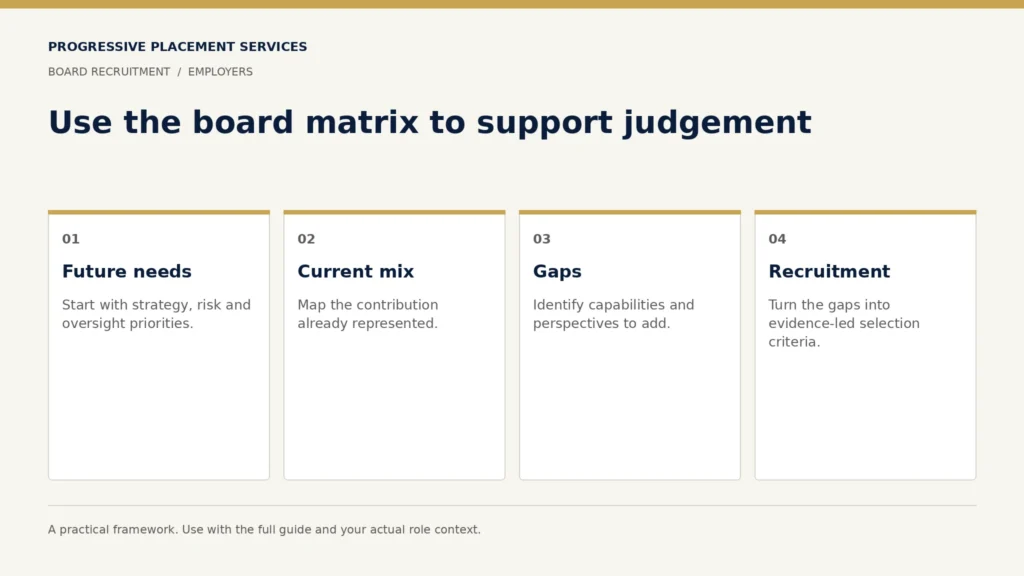
A board skills matrix is a working record of the capabilities the board needs, the evidence currently available and the gaps recruitment or development should address. Start with the organisation's strategy and oversight responsibilities, then consider individual directors as contributors to the whole board.
The matrix below is an illustrative planning tool. It should support discussion, not mechanically rank people or reduce governance to a list of professional labels. Use it alongside the organisation's governing documents and the actual responsibilities of the appointment.
Start with the board's future work
Before rating current strengths, ask what the board will need to understand and oversee. A significant investment, leadership transition, new funding model or change in service delivery can alter the questions directors must be equipped to ask.
Distinguish board oversight from management delivery. Hiring a director with technology experience does not transfer the organisation's implementation work to that director. Equally, a financial specialist should not become the only person expected to understand financial information.
The Institute of Corporate Directors describes board recruitment in terms of matching experience and competencies to governance needs. That provides useful context for the exercise; the matrix here is an original editorial worksheet, not an ICD assessment or certification.
Define capabilities through contribution
Replace broad headings such as “strategy” or “leadership” with a description of the contribution required. For example, a board may need experience evaluating major investment choices under uncertainty, or understanding the organisational consequences of a change in service model.
Include how directors work together. Sound judgement, constructive challenge, preparation and the ability to listen matter when a board is making difficult decisions. A matrix that records only qualifications and employer names can miss those features.
Consider perspectives and lived experience relevant to the organisation's mission and communities. Avoid treating one appointment as a proxy for an entire population or expecting one director to speak for everyone with a similar background. Ask what the board needs to learn and how it will create the conditions for contributions to be heard.
Copy this board skills matrix
Keep the full board discussion separate from confidential individual notes. The rows below are examples to adapt; they are not a universal governance standard.
| Capability needed | Evidence to discuss | Current depth and dependency | Next action |
|---|---|---|---|
| Strategy and judgement | Examples of considering alternatives and consequences | Is expertise shared or concentrated? | Clarify future decisions requiring experience |
| Finance and resources | Relevant oversight, investment or financial responsibility | Can the board challenge and interpret information together? | Identify development or recruitment need |
| Sector and operating context | Understanding of the organisation's customers, services or mission | What important context is missing? | Seek specific complementary experience |
| People and leadership oversight | Experience with leadership assessment and organisational change | Who can contribute to succession discussions? | Define the required contribution |
| Technology and risk | Relevant governance questions and decision experience | Is knowledge current enough for planned change? | Add learning or expertise as appropriate |
| Stakeholder understanding | Evidence of listening, collaboration and contextual judgement | Whose perspectives are absent from decisions? | Broaden engagement and candidate discovery |
For each row, add the date reviewed, the source of the evidence and the time horizon. Do not infer proficiency solely from a director's job title. Record “needs discussion” when evidence is incomplete instead of assigning a low rating by default.
Review depth, availability and renewal together
A board may appear to have a capability while relying almost entirely on one person. Consider committee responsibilities, upcoming departures, workload and whether other directors can contribute informed challenge. Recruitment can then address continuity as well as a present gap.
Keep succession timing explicit. A capability needed for a decision next year may need a different response from one needed immediately. Development, an adviser and a director appointment can play different roles; they should not be treated as interchangeable answers.
Review availability and potential conflicts through the organisation's appropriate process. Someone with relevant expertise may be unable to make the required commitment. Agree what time, preparation, committee work and other responsibilities the appointment involves before asking for a commitment.
Turn a gap into a director profile
A useful profile explains the contribution the board needs, why it matters now and the evidence that would support it. Keep essential requirements distinct from preferences. List the governance responsibilities and practical commitment clearly rather than publishing a long list of desirable achievements.
For a fictional example, a board considering a complex systems investment might need a director who can challenge implementation assumptions and organisational readiness. “Technology experience” is too vague. “Has overseen a consequential technology investment and can explain governance decisions, trade-offs and lessons” gives the selection process something to assess.
Use the companion board resume and bio guide to understand how candidates may present that evidence. A strong operating career can supply relevant experience, but it does not automatically demonstrate the contribution needed in a board setting.
Assess consistently without creating false precision
Agree a small number of common questions and the evidence the selection group will look for. Ask candidates how they have contributed to collective decisions, handled disagreement and judged the limits of their own expertise. Discuss a relevant hypothetical situation if it would clarify the required judgement.
Document what is demonstrated and what remains uncertain. The executive scorecard guide offers an evidence-recording approach that can be adapted, while preserving the distinction between board and management work.
Do not use a total matrix score to override material concerns or to assume that every capability has equal importance. The final decision should explain how the proposed appointment strengthens the whole board and fits the organisation's actual appointment process.
Make induction part of the recruitment plan
An appointment is the start of a contribution, not proof that a gap has been closed. Plan access to governing documents, strategy, key information and relevant organisational relationships. Clarify committee responsibilities, expectations and routes for asking questions.
Revisit the matrix as the organisation and board change. A short, useful review can identify learning needs and inform succession before an urgent vacancy appears. The purpose is a better-informed board, not a permanent table that everyone completes once and forgets.
PPS's Board Recruitment practice explains its scope. If you are preparing a director appointment, request a board recruitment conversation and share the contribution the board needs, its timing and the gaps your matrix has identified.