
Executive Resume in Canada: Examples That Show Leadership Scope
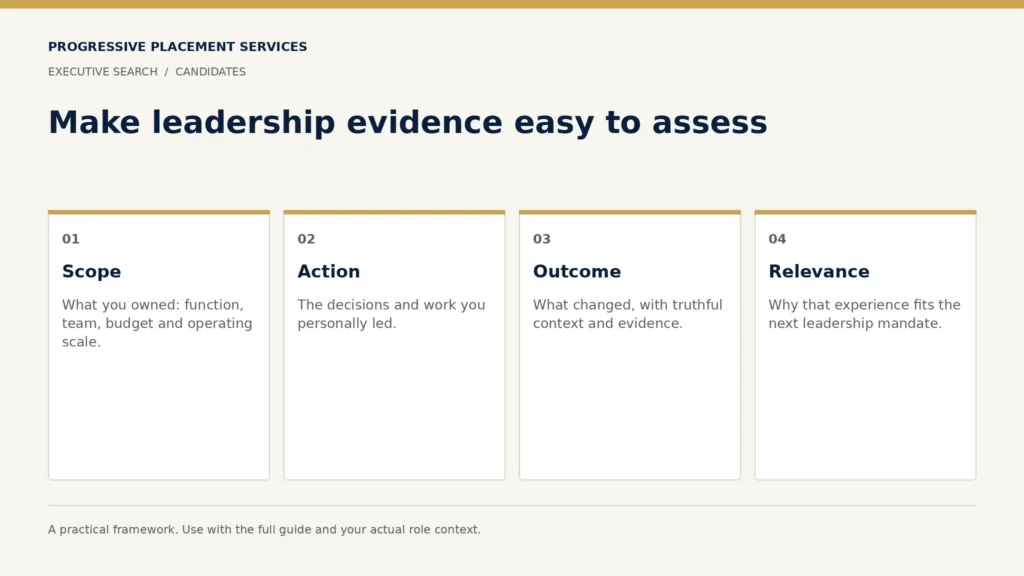
An executive resume should make three things easy to assess: the responsibility you held, the decisions you made and the results you can support. A senior title alone leaves too much unanswered. The reader needs to understand whether your experience matches the actual size and purpose of the next role.
Start with the mandate you want, then select evidence that supports it. This guide includes a document structure, fictional worked examples and a worksheet you can copy. If the missing piece is experience rather than wording, use the executive leadership development guide alongside it.
Decide which executive role this document is for
Write a one-sentence target before editing your work history: “I am seeking an operations leadership role in a multi-site industrial business where service reliability and manager development matter.” A useful target identifies function, organisational setting and the kind of problem you can address.
Compare that sentence with the actual vacancy or search brief. Underline the responsibilities you have already held, circle adjacent experience and mark genuine gaps. Do not turn every requirement into a claimed strength. The Job Bank resume guide recommends relevant accomplishments and honest presentation; the practical task is choosing evidence that fits this particular role.
Create a complete private career inventory first. Your submitted resume is a selection from that inventory, not a storage place for everything you have done. Keep an earlier role when it explains an important capability; compress work that adds little to the target mandate.
Build an opening profile that explains your scope
Replace strings of adjectives with a short description of your work. Mention the function you lead, the scale you know and the business circumstances where you have delivered. Explain an unfamiliar company in a few words so the reader does not need to research it.
Illustrative profile — fictional, not a PPS candidate or placement:
“Operations leader with experience directing service delivery across four industrial branches. Led branch managers, coordinated a regional operating budget and improved the consistency of maintenance planning during an acquisition integration. Seeking a general management or VP Operations mandate in a practical, multi-site organisation.”
That profile establishes a setting without claiming enterprise responsibility the person did not hold. Add a designation only if you currently hold it and it is relevant. A sentence such as “trusted strategic visionary” supplies no comparable evidence.
Use a readable executive resume structure
A clear document can follow this order. Adapt it to application instructions and the evidence you need to present rather than forcing a universal page rule.
| Section | What belongs here | What the reader should understand |
|---|---|---|
| Contact and professional heading | Name, reachable phone/email, relevant profile link, location or mobility context | How to reach you and what work you do |
| Leadership profile | Function, scale, mandate fit | Why this application is relevant |
| Recent experience | Employer context, title, dates, scope and selected achievements | What you owned and delivered |
| Earlier relevant experience | Concise roles or career history | How your background developed |
| Education and credentials | Accurate current qualifications and relevant development | What preparation you can substantiate |
| Governance or other contribution | Relevant appointments, committees or volunteer leadership | Additional contribution, accurately labelled |
Under each recent role, include a scope line before achievements. For example: “Reported to the president; led three department managers and an operating team of 45; accountable for regional service delivery.” Those details are fictional illustrations, not thresholds for an executive title.
Follow a coherent fictional executive resume excerpt
This additional example shows how the main parts fit together. Morgan Lee and Example Industrial Services are fictional; no real candidate, client or PPS outcome is represented. Contact details are placeholders.
Morgan Lee — operations leadership
Contact: your phone, professional email and relevant profile link. State your current location and the work locations you would consider.
Profile: operations leader with experience in multi-branch industrial service delivery, manager development and integration work. Interested in a broader general management or VP Operations mandate with clear commercial and people responsibility.
Regional Operations Director — Example Industrial Services, 2021–present
Reports to the president; leads four branch managers and is accountable for regional service delivery and an agreed operating budget.
- Introduced a shared maintenance-planning review during a branch integration, working with finance and local managers to clarify responsibilities.
- Prepared resource options for executive review when service requirements exceeded available capacity, explaining the delivery and cost implications.
- Developed branch managers to lead routine performance discussions and planning reviews within agreed authority.
Earlier experience: include your actual roles, dates and relevant progression, with enough detail to explain how your responsibility developed.
Education and credentials: list your real qualifications, current designations and relevant completed learning. Include governance experience separately when it supports the role.
The example supplies a document pattern, not ready-made achievements. Replace every statement with facts you can explain and support.
Describe team, budget and commercial responsibility accurately
Distinguish the budget you controlled from spending you monitored. Separate direct reports, indirect teams and project participants. If you managed a department inside a larger group, make that boundary visible.
The same care applies to profit and loss responsibility. Preparing a forecast, advising a business unit and owning its profit and loss are different experiences. Explain your actual authority: setting prices, approving resources, recommending investment or reporting performance.
Where information is confidential, use an approved range or a qualitative description. “Led finance for a privately owned, multi-entity manufacturer” may be more appropriate than disclosing unpublished revenue. Do not take confidential records into an application to make a claim look convincing. Discuss what can be shared and when.
Turn duties into evidence of achievement
Use a simple sequence: context → your action → result → boundary. The boundary explains your contribution and prevents a team outcome being presented as an individual achievement.
These examples are fictional demonstrations. Replace every detail with your own evidence.
| Duty-style wording | Stronger, evidence-led wording |
|---|---|
| Responsible for monthly reporting | Reorganised reporting responsibilities across three entities and introduced a review timetable that made the monthly pack available before the operating review. |
| Excellent people leader | Developed two team leads to take responsibility for shift planning and performance conversations, reducing dependence on the department manager for routine decisions. |
| Delivered major transformation | Led the operations workstream of a branch integration, agreed responsibilities with finance and HR, and introduced a shared maintenance-planning process. |
A number is useful when it has a clear basis. If you claim a reduction, record the starting point, end point, period and measurement method privately. If the result cannot be quantified reliably, describe what changed and how it was assessed. Do not invent a percentage to make a sentence look stronger.
Copy this achievement worksheet before writing
Complete one row for each example you may use. Keep the supporting detail in your private preparation notes; publish only what you are entitled to share.
| Prompt | Your notes |
|---|---|
| What was happening? | Business problem, starting conditions and relevant constraints |
| What were you authorised to decide? | Your role, boundaries and resources |
| What did you personally do? | Decisions and actions, distinguishing collaborators |
| What changed? | Supported result, trade-off or lesson |
| What could confirm it? | Appropriate reference, approved example or reliable measurement |
| Why does this matter for the target role? | The specific responsibility it demonstrates |
If a row contains only “supported,” “assisted” or “involved,” explain the contribution more precisely. Supporting a major programme can be relevant; claiming ownership of the whole programme is not necessary.
Adjust for director, VP, C-suite or board work
For a director role, give room to functional leadership and the managers or specialists you lead. For a VP or enterprise role, show how decisions crossed functions, affected resources or shaped organisational outcomes. The exact distinction depends on the employer; titles are not consistent between organisations.
A board application needs a different emphasis: oversight, judgement, committee contribution and relevant expertise. Use the board resume and bio guide rather than merely shortening an operating resume. An interim application should foreground comparable mandates and availability, as explained in the interim executive resume guide.
Check clarity, consistency and the next step
Use standard headings, readable type and a layout that remains understandable when text is copied out. Follow the employer's file instructions. Open the exported document on another device and check dates, links, page breaks and contact details. No document format guarantees that every recruitment system will interpret it perfectly.
Compare your resume with your professional profile and application form. Explain legitimate differences in emphasis, but correct conflicting dates or inflated titles. Leave out unnecessary personal details such as a photograph, date of birth or Social Insurance Number. The PPS Resume Studio is an optional way to prepare a clear document; you can also submit your existing resume.
If a current role fits, apply through that listing. Otherwise, candidates based anywhere in Canada can register a resume with PPS and state the work and locations they would consider. Registration expresses interest in current or future opportunities; it does not guarantee a matching vacancy. Read how PPS works with candidates before submitting.