
How to Hire a COO: Define the Mandate Before Starting Search
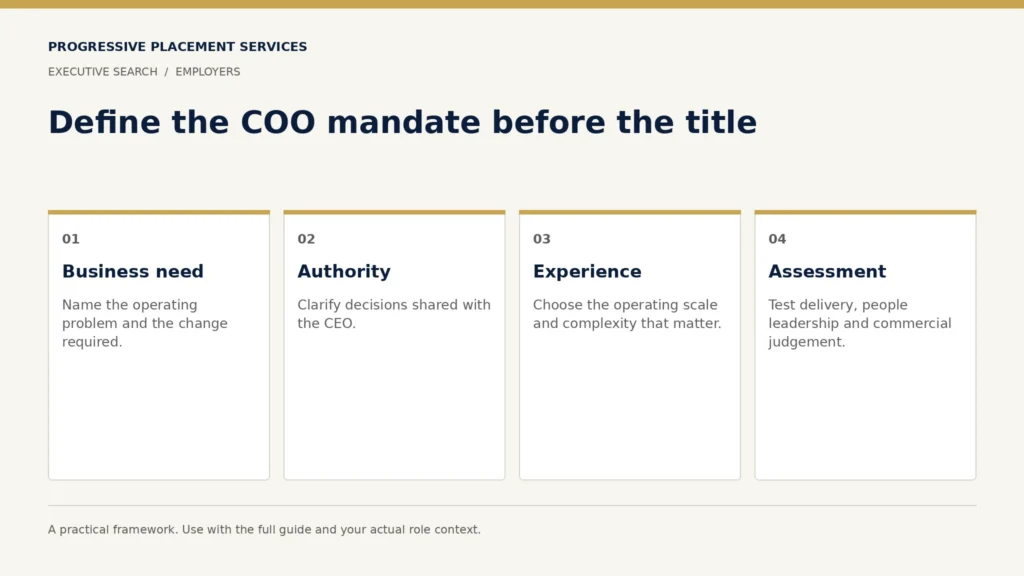
To hire a chief operating officer, first decide which operating decisions the business needs someone to own. Define the relationship with the chief executive, the functions included, the resources available and the outcomes that would show the appointment is working. Then assess candidates against that specific mandate.
A COO title alone does not settle any of those questions. This guide offers a working brief and assessment sequence for Canadian employers considering the role, including situations where an operations director, general manager or interim leader may fit better.
Decide which problem the appointment must solve
Start with the pressure that prompted the conversation. Is the organisation struggling to execute a growth plan? Does it need consistent delivery across several sites? Is a founder carrying too many operating decisions? Has an acquisition created overlapping teams and systems?
These situations can require different experience. Someone who has built a repeatable operating model in a growing business may face a different challenge from a leader stabilising an established operation. Avoid combining every possible operational problem into a single job description.
Describe what would happen if the role stayed vacant. This helps distinguish an important executive mandate from a collection of tasks that existing managers could own with better clarity. It also makes the urgency more concrete than simply saying the business needs someone immediately.
Compare COO, operations director and general manager responsibilities
Titles vary between organisations. Use this comparison to discuss scope rather than to establish universal definitions or title hierarchies.
| Working role description | Possible focus | Question to settle before search |
|---|---|---|
| COO | Execution across several functions or major operations | Which enterprise decisions move from the CEO to this role? |
| Operations director | A defined operating function, network or delivery system | Where does the role's authority end? |
| General manager | An identifiable business unit, region or operating business | What commercial and financial results does the unit own? |
| Interim operating leader | A bounded gap, transition or recovery mandate | What must be delivered and handed over? |
An impressive title attached to limited authority can disappoint both the organisation and the candidate. Conversely, a smaller business may need a broad hands-on leader without needing every layer associated with a large-company COO position.
Agree the relationship with the CEO
Write down which decisions the COO can make, which require consultation and which remain with the CEO or board. Cover priorities, expenditure, structure, key appointments and escalation. Specify who owns commercial strategy, product choices and customer commitments where those responsibilities touch operations.
The CEO should be ready to explain how the partnership will work in practice. If they intend to retain all consequential decisions, that is important information for the search. A candidate should not discover after joining that delegated responsibility comes without the authority to act.
Discuss disagreement too. Identify the regular operating forum, the information both leaders need and the route for resolving competing priorities. A clear relationship does not eliminate disagreement; it gives the organisation a way to handle it without sending contradictory instructions through the management team.
Complete a COO mandate worksheet
Copy these prompts into a working document. Use concrete answers and record unresolved questions. The examples are fictional illustrations, not PPS placement cases.
| Brief field | What to record | Illustrative answer |
|---|---|---|
| Business problem | The operating constraint behind the hire | Delivery commitments are set without a shared capacity view |
| Scope | Functions, sites and reporting relationships | Lead operations and service delivery; finance remains separate |
| Authority | Decisions the role can make | Reallocate approved capacity and set operating priorities |
| Outcomes | Observable changes, with measures agreed internally | A usable capacity plan and consistent escalation process |
| Dependencies | Conditions the organisation must provide | Reliable demand information and CEO support for prioritisation |
| Team | Strengths, vacancies and support needs | Capable site managers who need a shared planning routine |
| Transition | What must be learned or handed over | Existing customer commitments and site-specific constraints |
If stakeholders give contradictory answers, resolve them before publishing a candidate profile. Search can reveal market realities, but it cannot repair an internally inconsistent mandate without a decision from the organisation.
Look for comparable complexity, not simply a bigger employer
Ask what made a candidate's previous responsibility difficult: the number of operating locations, pace of change, customer obligations, technology, capital intensity or management capability. Revenue and headcount can help describe scale, but they do not capture every relevant feature.
Explore the resources behind the candidate's results. A leader accustomed to extensive specialist support may need to work differently in a lean organisation. Someone from a smaller business may have broad decision experience that transfers well, provided the gaps are understood.
Assess the candidate's ability to learn your operating context. Experience in the exact sector can be important, but familiarity should not be confused with judgement. Specify which knowledge must be present on arrival and which can reasonably be built through induction.
Assess commercial decisions, people leadership and execution
Use the executive hiring scorecard to connect the mandate to evidence. Ask for an example of a consequential operating decision, the alternatives considered and the outcome. Follow the story through implementation rather than stopping at the strategy presentation.
For people leadership, explore a situation involving conflicting priorities, management capability or a difficult performance problem. Ask what the candidate personally did and how the organisation sustained the change. Do not accept “we transformed the business” without understanding who owned which work.
For an industrial or infrastructure setting, the VP Operations hiring guide offers more specific scope questions. These should be adapted to the actual role; not every COO needs project-delivery or multi-site industrial experience.
Plan the transition before making the offer
Identify the relationships, decisions and information the incoming leader will need first. Agree how the CEO will introduce the role and explain its authority. Plan access to operating information, customer obligations and the managers whose work will change.
Set an early review of the mandate rather than expecting the first brief to predict everything. The purpose is to check assumptions, surface constraints and agree practical priorities. It is not a promise that a new executive can solve long-standing problems in a fixed number of days.
Decide whether retained executive search fits
Retained search may be useful when the organisation needs a deliberate market approach and careful assessment of relevant leadership experience. It is still worth considering an internal successor or a different role design if either addresses the actual need.
PPS describes its approach in the Executive Search practice and employer search process. To discuss a potential COO mandate, request a confidential search conversation. Bring the business problem, draft decision rights and the questions you have not yet resolved.