
Interim, Fractional or Permanent Executive: Which Hire Fits the Need?
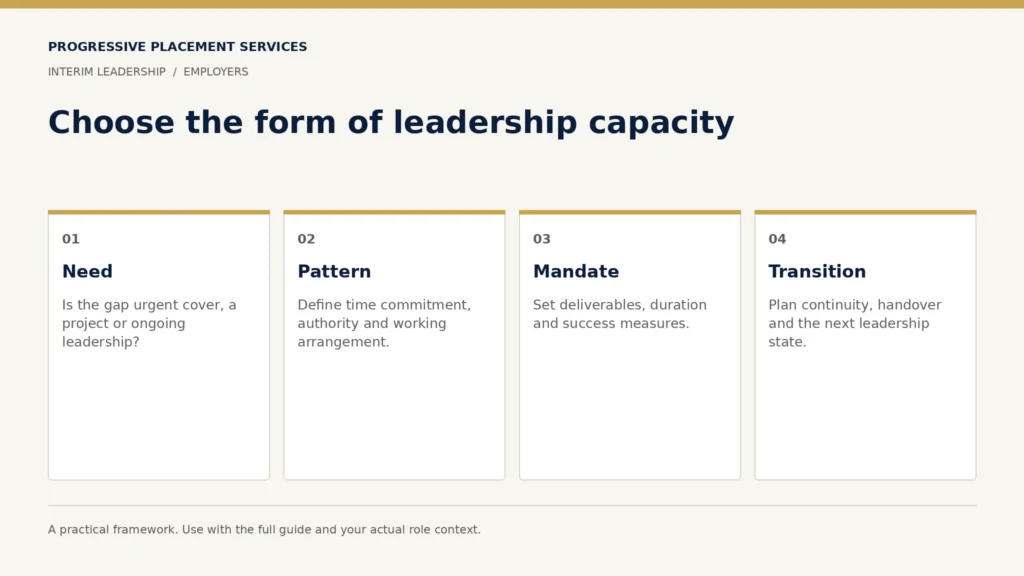
Choose executive capacity by separating the duration of the need, the working pattern and the authority the person must hold. An interim appointment addresses a bounded gap or transition. A fractional arrangement supplies a portion of an executive's capacity. A permanent appointment addresses an ongoing seat. These descriptions can overlap, so the written mandate matters more than the label.
For example, an organisation might need an interim executive on a part-time pattern, or continuing fractional support without a planned near-term end date. Start by describing what must happen and when someone needs to be available, then decide which arrangement can deliver it.
Separate duration, capacity and accountability
Three questions prevent much of the confusion. Is the responsibility continuing or linked to a defined situation? How much capacity is actually needed, including access between planned working days? Does the person need decision authority, or are they being asked to advise someone who retains it?
An adviser and an accountable executive can contribute different things even when both work a limited number of days. If the organisation expects someone to approve decisions, lead staff and manage delivery, those responsibilities need to be explicit. Do not hire advisory availability while assuming executive coverage.
PPS's Interim Leadership practice describes contract and fractional executive coverage for vacancies, transitions and leave. Whether a particular need fits depends on the mandate and availability; a service description does not establish that a suitable person can start on any requested date.
Compare the options against the actual need
The table offers working distinctions for scoping. It is not a statement of legal employment status or a universal definition of the terms.
| Option | Useful question | Mandate feature to clarify | Transition question |
|---|---|---|---|
| Interim executive | What bounded gap or change needs leadership now? | Authority, deliverables and intended duration | What must be handed to a successor or existing team? |
| Fractional executive | Can the work be done with a defined share of executive capacity? | Working pattern, availability and priorities | How will the organisation retain continuity between working periods? |
| Permanent executive | Does the organisation need a continuing accountable seat? | Long-term responsibility and resources | What support will make the appointment sustainable? |
Cost alone is an incomplete comparison. Consider the consequences of an uncovered decision, delayed handover or insufficient capacity. Obtain clear proposals for the actual scope rather than assuming one arrangement is always cheaper or faster.
Match the arrangement to the business problem
A sudden departure may leave an immediate leadership gap while a permanent search runs. The interim mandate might focus on continuity, essential decisions and a useful handover. That is different from asking the same person to redesign the entire function and implement a major transformation.
A smaller organisation may need senior judgement without a full-time volume of work. Fractional capacity may be worth considering when responsibilities and access can be planned realistically. It is less convincing when the role needs continuous on-site decisions but the organisation is simply hoping fewer days will be enough.
An ongoing leadership need should be assessed as an ongoing seat even if interim cover is useful first. If the organisation has not decided what the permanent role should own, allow time to resolve that question. Do not let temporary arrangements quietly become an undefined substitute for a decision.
Use this leadership-capacity worksheet
Copy the questions below into an initial brief. Complete the essential facts before choosing a preferred label.
| Question | Answer to record | Why it changes the brief |
|---|---|---|
| What cannot remain uncovered? | Specific decisions, leadership duties or operating commitments | Defines necessary accountability |
| When is coverage needed? | Earliest practical start and any immovable event | Tests whether availability matches the problem |
| What is the likely duration? | Known end event, estimate or ongoing need | Shapes the transition and review points |
| What capacity is required? | Planned days, on-site needs and response expectations | Prevents a mismatch between access and responsibility |
| What authority is available? | Decisions, resources and reporting relationships | Makes delivery possible |
| What would a useful handover contain? | Decisions, risks, routines and remaining work | Keeps continuity visible from the start |
If timing is uncertain, say what creates the uncertainty. A returning colleague, acquisition milestone and permanent hire have different dependencies. The engagement can then include sensible review points instead of relying on an unrealistic fixed finish.
Assess relevant delivery, not only an impressive permanent career
Ask for evidence of entering an unfamiliar organisation, identifying priorities and working with existing managers. Explore how the candidate learnt the context, established trust and decided what not to change. Someone can have a strong executive record without having demonstrated these particular conditions.
Use a relevant assignment example and distinguish what the individual delivered from what the wider team owned. Ask how they left the work in a usable state. An executive who creates a process only they can operate may not have solved the organisation's continuity problem.
The interim executive resume guide explains how candidates can present bounded mandate evidence. Employers can adapt the executive hiring scorecard to capture the few capabilities that matter for the proposed engagement.
Make the working pattern practical
Clarify when the executive will attend key meetings, how decisions reach them and what happens during an urgent issue. Identify an internal contact who can keep information moving. A calendar that looks affordable can fail if the organisation cannot reach an accountable decision-maker when work depends on it.
For fractional work, choose priorities that fit the available capacity. If the organisation adds another major responsibility, revisit the time and resources required. For interim work, confirm who handles activities outside the agreed mandate so necessary operational duties are not overlooked.
Set expectations for documentation, confidentiality and access to information. The executive needs enough context to act, while the organisation needs a deliberate process for granting and later removing access. Record responsibilities clearly rather than leaving them to assumptions about the title.
Agree the handover and the review points
Define the information a successor or existing manager should receive: current priorities, important decisions, unresolved risks, operating routines and relationships. Begin that record during the assignment instead of trying to reconstruct it at the end.
Review whether the original need has changed. A continuity assignment may reveal a different permanent role, or a planned short-term gap may last longer. Discuss the consequences explicitly, including capacity and authority, before adding substantial work.
For a continuing appointment, see the Executive Search practice. To discuss temporary or fractional leadership capacity, request an interim search conversation. Share the uncovered responsibilities, start requirement and intended working pattern so PPS can assess the fit.