
How to Develop Executive Leadership Skills: A Practical Evidence Plan
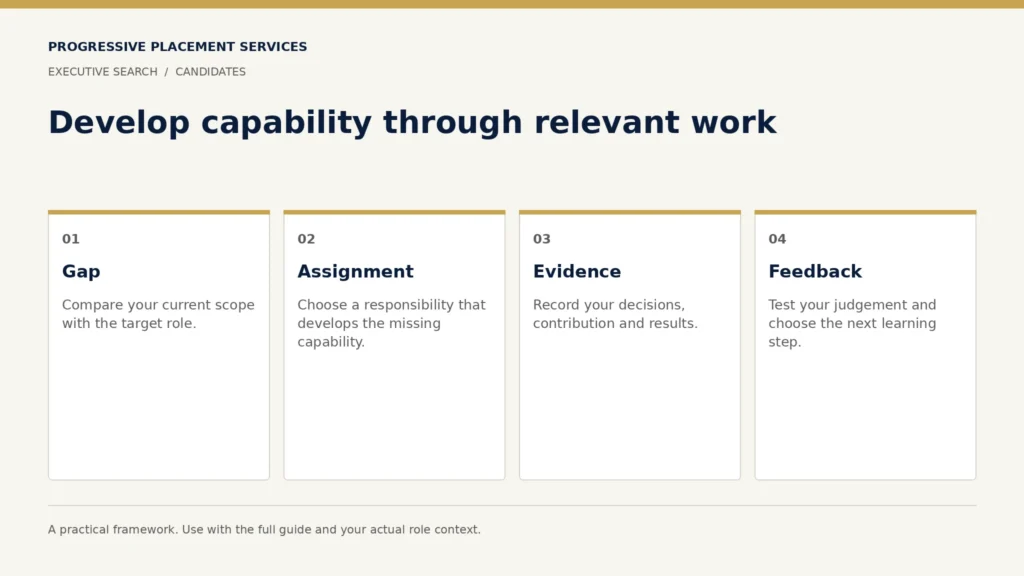
Developing executive leadership skills means taking responsibility for decisions with wider consequences, then learning from the results. A course can introduce useful ideas. Readiness also depends on applying judgement with people, resources, uncertainty and competing priorities.
Begin with a real target role rather than a list of impressive skills. This guide helps you identify a gap, choose a useful assignment and keep evidence of what you learn. The suggested 30-, 60- and 90-day checkpoints organise learning; they are not a promise of promotion or executive readiness within three months.
Compare your current responsibility with the target role
Choose two or three relevant role descriptions and list their recurring decisions. Ask what the person must own, who depends on them and what happens when they make the wrong call. A director role in a small organisation may differ substantially from the same title in a large group.
For each responsibility, mark your experience as observed, supported, owned or owned repeatedly. Watching a board presentation is useful exposure; preparing the recommendation and answering questions is different evidence. Do not treat those stages as interchangeable.
Discuss the assessment with someone who knows your work. Ask for a specific example that supports their view and one situation where your current approach may fall short. You are looking for a development decision, not reassurance that a new title is deserved.
Use a skills-to-evidence matrix
The following is an original planning worksheet, not a validated assessment test. Adapt the capabilities and evidence to your target organisation.
| Capability | Useful experience to seek | Evidence to record |
|---|---|---|
| Commercial judgement | Compare options for a real resource or operating decision | Assumptions, trade-offs, recommendation and eventual result |
| People leadership | Develop managers, address performance and plan coverage | Changes in responsibility, feedback and team capability |
| Strategy | Translate an organisational priority into a workable plan | Choices made, resources required and measures reviewed |
| Cross-functional influence | Resolve a problem shared by operations, finance or another team | How agreement was reached and what each party owned |
| Risk and governance | Present an issue through the appropriate decision process | Escalation, controls, uncertainty and decision authority |
| Change leadership | Implement a meaningful change with those affected | Adoption, service impact, problems and adjustments |
The Treasury Board leadership competency profile offers a useful example of observable leadership expectations. It is a framework for Canada's federal public service, not a universal private-sector hiring standard. Use it to sharpen questions, then check what the actual role requires.
Build commercial judgement through real decisions
Ask to work on a business case, operating review or resource decision within your authority. Start by explaining the problem before proposing an answer. Identify the options, relevant costs, assumptions and likely effect on customers, employees and delivery.
For example, an operations manager might compare adding a shift with changing the maintenance schedule. The useful learning is not simply building a spreadsheet. It includes asking whether demand is durable, whether supervision is available and what could make the preferred option fail.
After the decision, compare the result with the assumptions. Record what you would change next time. Avoid retrospectively rewriting the original judgement so it appears more certain than it was. Sound executive judgement includes knowing which uncertainty mattered.
Develop people leadership beyond individual performance
Leading a team well does not mean personally solving every problem. Seek opportunities to delegate a defined responsibility, agree the standard and support someone else to deliver it. Explain where their authority ends and what they should escalate.
Practise feedback before a problem becomes a formal crisis. Use specific observed behaviour, explain the work impact and agree a next step. Follow your employer's people-management processes and involve the appropriate support for sensitive matters.
Build succession into ordinary work. Who can cover a key responsibility when you are absent? What preparation would make that safe and effective? A useful leadership example might show how another manager became more capable, rather than how often you rescued a task yourself.
Learn strategy, risk and governance through scoped assignments
Volunteer for an assignment with clear sponsorship and boundaries. Examples include integrating a small acquisition workstream, improving a cross-team service, reviewing a supplier dependency or preparing an investment recommendation. Agree the expected outcome and the time you can reasonably devote to it.
Ask to present the recommendation to the decision-makers when appropriate. Explain the assumptions, alternatives and unresolved questions. Receiving a difficult question is an opportunity to understand what senior leaders need before committing resources.
Governance exposure does not require claiming that you made the board's decision. You might prepare reliable information, follow an approval process or report an emerging risk. State the contribution accurately when you later use the experience in a resume or interview.
Choose the right learning method for the gap
Use formal learning when you need concepts, language or technical foundations. Use a supervised assignment when you understand the concept but lack application. Use a mentor or coach when you need help examining judgement, behaviour or a difficult transition.
| If the gap is… | A practical next move | Check before committing |
|---|---|---|
| Financial understanding | Study the basics and join an operating review | Can you apply the learning to an authorised decision? |
| Leading managers | Take a scoped management responsibility with feedback | Are expectations, support and escalation clear? |
| Strategic communication | Prepare a decision paper and present it | Does the audience receive a clear recommendation? |
| Sector knowledge | Work with experienced colleagues on a relevant assignment | Are you learning the actual operating constraints? |
Compare programmes by learning outcomes, assessment, time, cost and relevance. Do not assume an expensive course or another certificate will compensate for a missing record of responsibility. Equally, do not reject education when a genuine knowledge gap is holding back safe, competent practice.
Use 30, 60 and 90 days as learning checkpoints
First 30 days: choose the target responsibility, identify one important gap and agree a small assignment. Write down who sponsors it, what you may decide and how progress will be reviewed.
By 60 days: test your approach through the assignment. Seek feedback from someone affected by the work as well as your manager. Note what changed when you encountered a constraint or disagreement.
By 90 days: review the evidence. Did you practise the capability, or only complete an activity? Decide whether to repeat the work at greater complexity, address a different gap or continue building experience over a longer period.
Some capabilities take years and multiple settings to establish. The plan is useful even when its conclusion is that the next appropriate role is a broader management position rather than an executive appointment.
Keep an evidence log and test readiness honestly
For each assignment, record the context, responsibility, action, result, feedback and lesson. Use approved material and protect confidential information. Record a disappointing outcome when it reveals a change in judgement or process; an evidence log is not a collection of flawless success stories.
Before seeking the next role, ask whether you can explain your examples without inflated language. What did you own? What did others contribute? What would a reference confirm? The executive hiring scorecard shows the employer side of this evidence question, while the executive resume guide helps you present it clearly.
For finance leaders, the controller-to-CFO pathway adds function-specific development questions. If you want to discuss relevant opportunities, share your resume and next-role interests with PPS. Candidates across Canada are welcome to register; a registration is not an application to a particular advertised vacancy or a guarantee of placement.