
Hiring a Healthcare Leader: Define Service Outcomes and Assess Experience
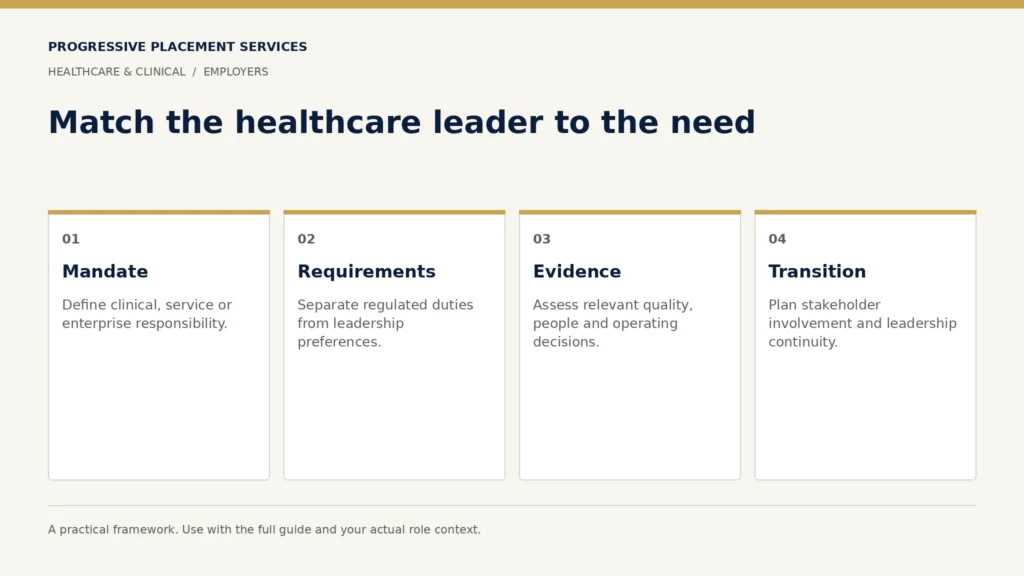
Hiring a healthcare leader starts with the service responsibility, not the title. Define whether the role leads clinical practice, a service or facility, a professional group or the wider organisation. Then separate any role-specific registration requirements from the leadership capabilities needed to deliver the mandate.
A good brief makes quality, people, resources and stakeholder responsibilities concrete. The worksheet below helps employers assess those responsibilities without assuming that clinical seniority automatically proves executive readiness, or that a non-clinical leader should hold credentials unrelated to the actual duties.
Identify the seat and the service context
Describe the people served, delivery model, teams and relationships the leader will work with. A role across several sites presents different coordination questions from a role leading one service. An organisation undertaking major change may need different experience from one seeking continuity and management depth.
Name the problem behind the vacancy. Is it an uncovered leadership responsibility, a service redesign, workforce instability or a need for stronger operational coordination? Keep the explanation specific enough that a candidate can understand the work without receiving confidential patient or personnel information.
Agree who the role reports to and what it can decide. A leader cannot reasonably be accountable for improvement across services if the authority to coordinate them sits elsewhere and no workable decision process exists.
Set outcomes that describe meaningful service improvement
Choose measures that reflect the actual mandate. Depending on the setting, these might concern service reliability, access, quality, workforce stability, resource use or the implementation of a new operating approach. No single measure captures all aspects of a service.
Record the starting context and how measures are defined. Ask what could improve one number while making the wider service worse. For example, a faster process may be unhelpful if it shifts an unresolved problem to another team or excludes people who need support.
Include the dependencies the organisation must supply. Reliable information, agreed responsibilities and cooperation across professional groups can determine whether a proposed outcome is achievable. These belong in the mandate rather than appearing later as unexplained obstacles.
Separate registration from leadership evidence
When a role includes regulated professional duties, establish the applicable profession, jurisdiction and current requirements with the appropriate regulator. Verify relevant status through the proper source. Do not infer it from a familiar title or from experience in another location.
That verification answers a different question from whether someone can lead the proposed service. Leadership assessment should examine decisions, improvement, people and organisational responsibility. A role that does not perform regulated clinical duties may have a different credential profile; define its actual requirements before screening candidates.
For candidate preparation and current licensing-source routes, use the existing medical recruitment agency guide. The healthcare leadership career guide addresses development and evidence, rather than promising that a course or qualification grants access to a particular role.
Use the current leadership framework thoughtfully
The Canadian College of Health Leaders' refreshed LEADS framework for 2026 offers a language for discussing healthcare leadership. Its five domains include leading oneself, engaging others, achieving results, developing coalitions and shaping systems.
Use the framework to inform the questions appropriate to your mandate, not to claim that a candidate has passed a universal hiring standard. It is a leadership-development framework, distinct from professional registration and from the specific selection process an employer chooses.
For example, a service change may call for evidence of bringing different professional and operational groups into the decision. Ask how the candidate heard concerns, negotiated trade-offs and checked the effects. The answer should illuminate what the person did, not simply repeat the language of a framework.
Copy this healthcare leadership scorecard
This is an original illustrative worksheet, not a clinical protocol or validated selection instrument. Adapt it to the setting and the employer's actual responsibilities.
| Responsibility | Evidence to explore | Context to clarify | Open question |
|---|---|---|---|
| Service improvement | A change the candidate helped design and implement | Starting conditions, personal authority and sustained effects | What else contributed to the result? |
| People leadership | A workforce or team capability challenge | Professional mix, support available and communication | What changed for the team? |
| Resource decisions | A consequential budget or capacity choice | Competing needs, information and decision rights | Which trade-offs were accepted? |
| Collaboration | Work across services or organisations | Stakeholders, disagreements and follow-through | How were affected people involved? |
| Quality and risk | Relevant oversight and escalation experience | Boundaries of the role and specialist input | What did the leader learn from a concern? |
Keep credential verification in a separate requirement record. For the scorecard, record the example and remaining uncertainty rather than awarding points for a well-known employer or a polished presentation.
Ask for contextual evidence without confidential records
Invite candidates to explain a relevant improvement in a suitably de-identified way. Ask what was measured, why it mattered, what the candidate could influence and how the result was maintained. A percentage without its definition or setting is difficult to interpret.
Accept appropriate qualitative evidence where precise operational figures cannot be shared. A clear account of changed responsibility, a better escalation route or a team process can still be informative. Do not request patient information, protected personnel records or confidential material from another organisation.
Use consistent core questions for candidates, with follow-up to understand differences in their examples. The executive hiring scorecard offers a general method for making the team's reasoning visible while avoiding false precision.
Organise stakeholder assessment and transition
Choose participants according to what they need to assess. Clinical, operational and organisational perspectives can answer different questions; asking every stakeholder to repeat the same interview creates work without necessarily improving the decision.
Agree how views will be brought together and how unresolved concerns will be addressed. Keep the mandate visible when discussing differences. A candidate's willingness to challenge an assumption should not be confused automatically with an inability to collaborate.
Plan induction around the service context, key relationships and immediate decisions. Clarify how the incoming leader will learn from staff and the people affected by the service. Joining well requires organisational support as well as individual capability.
Discuss the mandate within the right practice scope
PPS's Healthcare & Clinical practice describes work with physicians, nursing leadership and healthcare administrators across Alberta and Saskatchewan. Canada-wide candidate interest does not mean every employer mandate or profession is covered in every jurisdiction.
For the wider process, see healthcare recruitment in Canada. If you have a relevant hiring need, request a healthcare search conversation and share the service responsibility, required profession where applicable, location and outcome behind the hire.