
Healthcare Leadership Careers: Build Experience for Director and Executive Roles
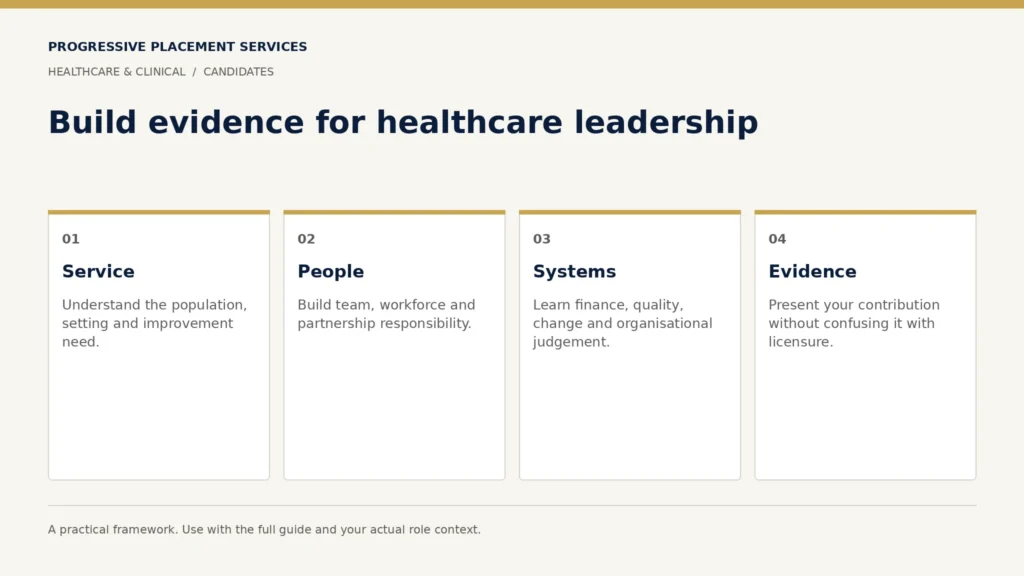
A healthcare leadership career requires evidence that you can improve services through people, resources and sound decisions. Clinical expertise can be valuable, but it does not by itself explain how you would manage a team, lead a service or take responsibility across an organisation. Non-clinical professionals can also develop relevant leadership experience.
Begin by identifying the kind of role you want: clinical leadership, operational management, specialist leadership or an executive mandate. This guide helps you choose development assignments and describe what you learn. It does not set licensing requirements or promise that a course leads to an appointment.
Distinguish clinical seniority from leadership responsibility
Read the actual duties of the target role. A senior clinical title may involve expert practice and supervision, while another role owns a budget, workforce plan or service improvement programme. An enterprise leader may need to balance several services and external relationships.
Do not assume titles follow one career ladder. Ask what decisions the role makes, which groups it leads and what outcomes it is accountable for. Clarify whether clinical practice is part of the work or whether the position is primarily administrative, operational or strategic.
| Current background | Experience worth exploring | What to clarify |
|---|---|---|
| Clinical practice | Service improvement, team coordination or appropriate supervision | Clinical and management responsibilities, with the required support |
| Finance, HR or operations | Cross-service planning and delivery | How your decisions affect patient-facing work |
| Technology or quality | A service change involving users and operating teams | Accountability, adoption and ongoing service ownership |
| Existing management | Broader resource, workforce or strategic responsibility | Scale, decision rights and the impact across services |
These are development options, not prerequisites for every healthcare role. Choose a path that matches your qualifications and the organisation's needs.
Use the current LEADS framework as a development lens
The Canadian College of Health Leaders' refreshed LEADS framework describes healthcare leadership capabilities. Its 2026 domains are Lead Self, Engage Others, Achieve Results, Develop Coalitions and Shape Systems.
Use the framework to ask better questions about your experience rather than treating familiarity with its language as proof of readiness. Which behaviour have you practised? What happened when it was difficult? Who can describe its effect on the work?
A development framework is different from professional registration or an employer's essential requirements. Check the specific role and current programme information before deciding whether formal learning is relevant. Do not describe yourself as certified simply because you have read a framework or completed unrelated training.
Gain experience in people and workforce decisions
Look for a defined responsibility that lets you practise communication, feedback and workload planning. Agree what you may decide, what must be escalated and who supports you. A stretch assignment should not place someone outside their competence or authorised role.
Examples could include coordinating an induction improvement, helping a manager plan service coverage or leading a cross-team review of a recurring operational problem. Explain the problem and listen to the people affected before proposing a solution.
Record how you dealt with disagreement, resource constraints and different professional perspectives. “Led a multidisciplinary team” is more useful when you can explain the membership, your authority and the work completed. Give appropriate credit to clinical, administrative and other colleagues.
Build financial and service-improvement understanding
Ask how the service uses resources and which decisions change its capacity. Learn the budget categories, staffing assumptions, demand patterns and reporting processes relevant to the role. Review decisions with experienced colleagues rather than treating the spreadsheet as the whole service.
For an improvement project, define the starting issue and the outcome you intend to examine. Include a way to notice unintended effects. A shorter wait for one stage may be unhelpful if it simply moves a delay elsewhere or adds workload another team cannot sustain.
Do not use patient stories or identifiable information in career materials. Describe work at an appropriate level and obtain permission before sharing internal documents. An application needs evidence of your contribution, not access to sensitive operational or personal records.
Copy this healthcare leadership evidence map
This is an original planning worksheet. It is not a clinical assessment tool or a substitute for an employer's selection process.
| Development area | A scoped assignment | Evidence to prepare |
|---|---|---|
| People and communication | Improve a team process with the responsible manager | Consultation, responsibilities and feedback |
| Resources | Contribute to a budget or capacity review | Assumptions, options and the decision you supported |
| Quality and service | Help evaluate a recurring service issue | Starting conditions, changes and limitations |
| Collaboration | Coordinate a problem spanning teams | How agreement and shared ownership were established |
| Change | Implement an approved service improvement | Adoption, problems encountered and adjustments |
| Wider systems | Examine dependencies outside your immediate team | Effects on partners, patients or other services, described safely |
Choose one area where the next role demands more than your current experience provides. Agree a manageable project and a review point. A series of well-supported responsibilities can be more informative than a broad title without clear authority.
Work through a specific example
Fictional illustration: a service coordinator wants to move into a management role. An appointment process repeatedly requires evidence of improving a service and working across teams. The coordinator has strong scheduling experience but has not owned a cross-team change.
With a manager's sponsorship, the coordinator helps review a recurring referral handoff problem. The assignment defines the teams involved, what information can be used, who approves changes and how the effect will be reviewed. The coordinator gathers feedback, prepares options and coordinates an agreed trial.
The eventual career example should identify the coordinator's contribution. It should not claim sole responsibility for a clinical outcome or describe the trial as a proven system-wide improvement. If the trial exposes a problem, explain the adjustment and what the experience taught about implementation.
Separate leadership learning from clinical registration
If a role includes regulated clinical duties, confirm the current requirements with the appropriate regulator for the profession and province or territory. Leadership education does not grant permission to perform regulated work. International qualification and registration questions also need their own current checks.
Use the existing international medical recruitment guide as an orientation to those separate questions, then follow the relevant official pathways. For the employer and recruitment context, see healthcare recruitment in Canada. Neither a shortage headline nor a leadership course means an individual is eligible for a particular position.
When comparing development programmes, consider the learning outcomes, applied work, assessment and time involved. Choose education that addresses a real gap. Check current eligibility and certification terms directly with the provider before making a financial commitment.
Prepare your resume and choose the next responsibility
Present the service context, team or resource responsibility, actions and supported results. Include current relevant qualifications accurately. The executive resume guide helps translate evidence into a readable document, and the healthcare hiring guide shows how an employer may define the mandate.
The appropriate next move may be a team, project or service management role rather than an immediate executive appointment. Seek feedback on the evidence and select the responsibility that develops the missing capability.
PPS's Healthcare & Clinical practice describes its current employer service scope in Alberta and Saskatchewan. Candidates across Canada can register their relevant experience and preferred locations. Apply through a specific listing when it fits; registration is interest for current or future opportunities, not a licensing decision or an assurance of a vacancy.