
Technology Leadership Careers: Moving Toward CTO, CIO and Head-of-Technology Roles
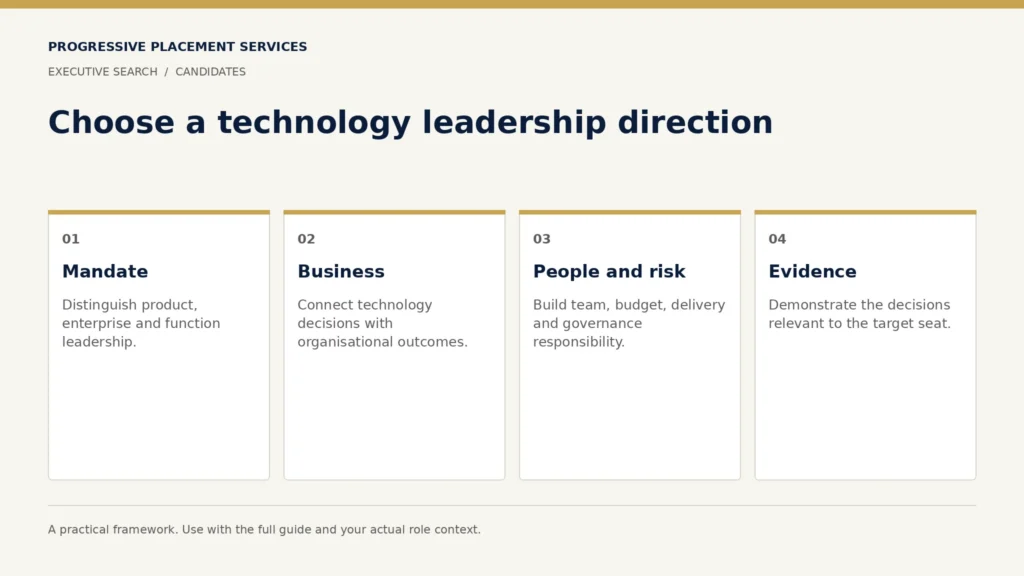
Moving toward a CTO, CIO or head-of-technology role means showing how your technical judgement connects to organisational decisions. An employer needs to understand the outcomes you can own, the people and resources you can lead and how you handle risk. A list of platforms or a larger engineering title will not answer those questions alone.
Begin with the mandate of a particular role. This guide helps you compare common emphases, choose relevant development assignments and build an evidence inventory. It does not prescribe one career ladder or suggest that a certificate guarantees executive readiness.
Distinguish the title from the technology mandate
CTO and CIO responsibilities vary between organisations. One CTO may lead a technology product and engineering function; another may have a different strategic or technical remit. A CIO may focus on enterprise technology and service, while a head-of-technology role can combine responsibilities in a smaller organisation.
Treat the comparison below as questions to investigate, not fixed definitions.
| Possible mandate | Questions to ask | Evidence that may be relevant |
|---|---|---|
| Product and engineering leadership | What product, architecture and delivery outcomes does the role own? | Engineering decisions connected to customer and business needs |
| Enterprise technology leadership | Which internal services, systems and changes are accountable to the role? | Service reliability, transformation and stakeholder decisions |
| Combined technology leadership | What can the team deliver directly and where are partners needed? | Prioritisation, resource choices and appropriate hands-on judgement |
| Specialist-to-leadership progression | Which responsibilities extend beyond the technical specialism? | People, commercial communication and wider delivery ownership |
Job Bank's information-systems management profile includes team, budget, systems and client requirements. It provides occupational context rather than an exact executive-role specification. Read the actual employer brief before deciding whether your experience matches.
Examine real role descriptions critically
Collect a few relevant first-party role descriptions and underline the decisions the leader must make. Separate essential experience, preferred background and organisation-specific priorities. Look at business model and scale alongside the title.
For example, a Toptal CTO role description, reviewed November 8, 2026, combines engineering strategy, architecture, workforce planning and team development. It illustrates one employer's mandate, not a universal CTO definition or a PPS vacancy. Published postings can change or close.
Ask what evidence each responsibility would require. Having used an AI tool, for example, does not establish that you have governed a production service or led a technology strategy. Choose examples that match the actual accountability rather than repeating fashionable terms from the advert.
Build commercial judgement through technology decisions
Seek a decision where the business has meaningful alternatives: build or buy, replace or extend, prioritise one service improvement or another. Agree your authority and the people who must contribute. Explain the problem before discussing the preferred technology.
Compare costs, delivery capacity, customer or user impact, operational burden and uncertainty. Separate a vendor claim from a tested organisational requirement. A useful recommendation tells decision-makers what they are giving up as well as what they may gain.
After the decision, review what happened. Did the team underestimate integration work or ongoing support? Did the change solve the original problem? Recording the lesson demonstrates judgement more clearly than describing every initiative as a transformation success.
Demonstrate delivery and service responsibility
Describe the product, system or service you led and who depended on it. Explain the boundary between your team, other internal groups and external suppliers. A reader should be able to distinguish architecture advice from accountable delivery or service ownership.
Use appropriate evidence: a reliable release process, an agreed service improvement, clearer ownership, a successful migration or the resolution of a recurring dependency. Define the measurement if you use a numerical result. Do not credit yourself with a business outcome that the evidence cannot attribute to the technology work.
For enterprise changes, explain adoption as well as implementation. A system being available is not the same as people using it effectively. Describe how operating teams were involved, what changed in their work and what remained unresolved.
Develop risk and governance understanding
Technology executives need to communicate risk in a form the organisation can act on. Clarify who owns a decision, which information is needed and what should be escalated. Seek feedback on a real risk discussion rather than treating a policy document as proof of leadership.
The NIST Cybersecurity Framework offers a structured resource for cybersecurity-risk management. Its CSF 2.0 Govern function provides one way to examine strategy, expectations and oversight. It is not a personal certification or a statement that one framework alone meets every organisation's obligations.
A practical development assignment might involve reviewing a supplier dependency, participating in a recovery exercise or helping translate a technical issue into a decision paper. Work within authorised processes and with the relevant specialists. Do not expose security-sensitive information in a resume or portfolio to demonstrate credibility.
Lead people, resources and other leaders
Show how you built the team's ability to deliver. Relevant evidence might include clarifying responsibilities, developing engineering managers, improving collaboration with product or operations, or planning capacity against competing priorities.
Separate direct reports, indirect teams and project participants. If you worked through suppliers, explain how you evaluated and managed that relationship. Do not describe every contributor to a programme as someone you line-managed.
For budget experience, state whether you prepared estimates, recommended allocation, approved spending or owned the budget. An executive application needs an accurate account of authority. It does not benefit from inflating a project budget into responsibility for all technology investment.
Copy the technology leadership evidence inventory
This original worksheet helps identify the next experience to seek. It is not a test or an employer scoring system.
| Area | Questions to answer | A possible development assignment |
|---|---|---|
| Business judgement | Which alternatives and trade-offs did you evaluate? | A scoped build-or-buy or prioritisation recommendation |
| Delivery and service | What did you own after launch? | Service improvement or migration with operating feedback |
| People leadership | Who developed and what responsibility changed? | Supporting a manager or clarifying team ownership |
| Resources | What capacity and spending decisions were yours? | An authorised planning or budget review |
| Risk and governance | What uncertainty needed a decision or escalation? | A cross-functional risk or dependency review |
| Executive communication | Could the audience act on your recommendation? | A short decision paper and feedback session |
Complete the inventory against the role you actually want. Label experience you have observed or supported separately from what you have owned. Pick a responsibility that would develop a meaningful gap rather than collecting unrelated certificates.
Turn technical work into a leadership example
Fictional illustration: an engineering manager wants a broader technology role. They have strong delivery experience but limited responsibility for cross-business prioritisation. With sponsorship, they coordinate options for replacing an internal platform and involve operations, finance and security specialists.
Their career example should explain the decision, alternatives, their responsibility and the outcome. It should distinguish the group recommendation from the final executive approval. If the organisation chose to retain the platform, the work may still show useful judgement; explain why that was the appropriate conclusion.
Keep technical detail when it helps assess the decision. Remove a catalogue of tools that obscures the work. Use the executive resume guide and leadership development plan to present evidence and plan the next responsibility.
Choose a relevant opportunity and register your interests
Read the technology leadership hiring guide for an employer view of mandate choices. PPS's Professional Recruitment practice includes technology professionals, while its Executive Search practice describes relevant senior leadership work.
Candidates based anywhere in Canada can register a resume and target technology roles, explaining function, scope, availability and preferred work arrangements. Apply through a specific advertised listing when it fits. Registration is interest for current or future opportunities; it does not mean a matching CTO, CIO or other vacancy is currently open.