
Executive Careers in Energy, Construction and Infrastructure: Prove Readiness
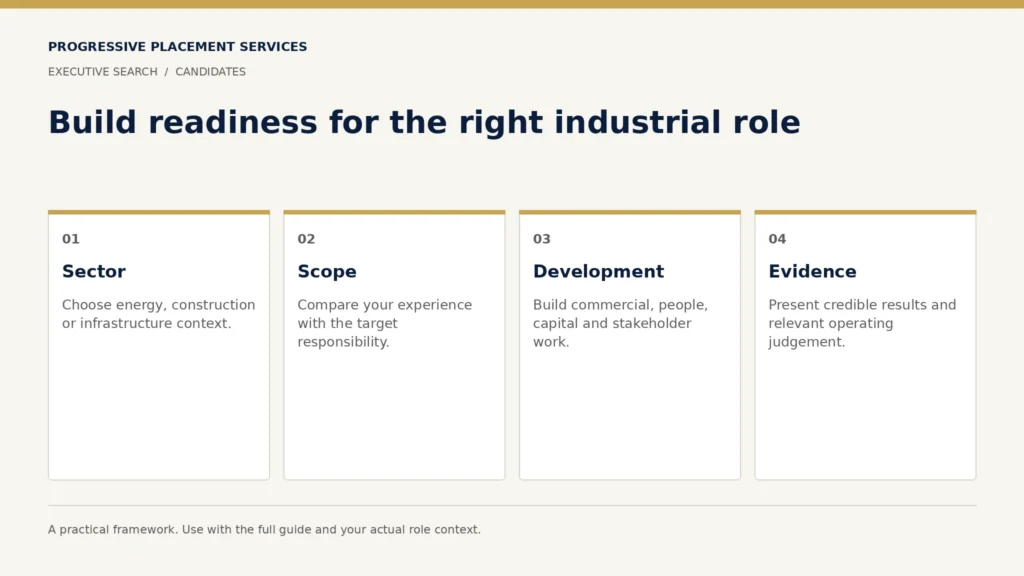
Executive careers in energy, construction and infrastructure require more than a broader version of a project or operations resume. A candidate needs to explain the operating setting they understand, the decisions they have owned and how that experience relates to the next mandate. Senior titles do not transfer automatically between sectors or company sizes.
Start by choosing a target function and business context. This guide compares several routes and provides an evidence worksheet. It offers development questions rather than a claim that one course, qualification or career sequence leads to an executive appointment.
Choose a sector, function and operating setting
“Industrial executive” is too broad to guide a useful application. Identify whether you want responsibility for operations, projects, finance, commercial activity or the whole business. Then describe the organisation: asset owner, contractor, service provider, developer or another setting.
Consider where you have actually made decisions. A project director may understand delivery on a defined contract but have less experience of a multi-site service business. An asset-operations leader may have strong reliability experience but need further exposure to competitive bidding or project development.
Write a target statement that identifies the work and context. For example: “I am seeking broader operations responsibility in an industrial service business with multiple branches.” This is a starting point for comparison, not language to copy if it does not reflect your interests and background.
Compare the sector-specific leadership questions
The examples below are an original planning comparison. Individual employers and mandates may combine these responsibilities differently.
| Setting | Questions a candidate should be ready to discuss | Evidence to develop |
|---|---|---|
| Energy asset or service business | How did you balance reliability, resources and long-term operating needs? | Operating decisions, capital planning and relevant stakeholder work |
| Construction contractor | How did you manage delivery obligations, resources and commercial exposure? | Project or portfolio accountability, planning and handover |
| Infrastructure owner or operator | How did you consider asset needs, service performance and multiple parties? | Lifecycle decisions, coordination and delivery within an agreed mandate |
| Industrial maintenance or field service | How did you organise people, equipment and consistent service? | Multi-site planning, supervision and operating improvement |
Do not treat the sectors as interchangeable. Learn the business model, decision cycles and consequences that shape the target role. Explain where your experience transfers and where you would need support.
Build responsibility beyond technical or project expertise
Technical knowledge can help you understand the work, but an executive application also needs evidence of resource choices, people leadership and business judgement. Seek an assignment where you must compare priorities rather than optimise only your own task.
For a project leader, that could involve a wider portfolio review, a resource-allocation decision or developing other project managers. For a site leader, it might involve coordinating a standard across locations while allowing for different operating conditions. Agree authority and sponsorship before taking on the work.
Record the trade-offs. What did the preferred option cost or make harder? Which risk remained? A credible example explains the conditions and limitations as well as the result. It does not rely on words such as “complex” or “strategic” to stand in for detail.
Develop capital, commercial and stakeholder judgement
Ask to contribute to a relevant investment or operating review. Learn which assumptions matter: capacity, demand, resources, delivery dependencies or the effect of an asset decision on future service. Explain what would make the recommendation change.
In its Canadian energy CEO leadership research, Spencer Stuart discusses long-term decisions, leadership teams and external stakeholder relationships. That research supplies sector context; it does not establish the requirements of every energy role or demonstrate PPS placement outcomes.
For stakeholder work, describe your actual responsibility. Preparing information, participating in engagement and leading an authorised relationship are different contributions. Respect the organisation's protocols and the expertise needed for regulatory, community or other sensitive matters. Do not present attendance at a meeting as ownership of the relationship.
Show how you lead people and other leaders
Explain whether you led individual contributors, supervisors, managers or a cross-functional group. Describe the decisions delegated and the support you provided. A large headcount can supply context, but it does not explain how the team became more capable.
A useful example might show how you prepared a supervisor to take over planning, resolved a recurring handover problem or developed a shared review process across sites. Explain your role and the observable change. Give appropriate credit to the people who delivered the work.
For a progression from trade or field experience, the tradesperson-to-supervisor guide provides earlier development steps. For wider executive responsibility, use the leadership skills evidence plan to identify gaps that are not confined to a particular industry.
Copy the industrial leadership evidence worksheet
Complete the worksheet for the target role and one or two significant examples. Keep your private notes separate from material you are entitled to share with an employer.
| Prompt | What to record |
|---|---|
| Operating context | Business model, geography, project or asset setting and relevant scale |
| Authority | The decisions you owned, recommended or escalated |
| Resources | People, budget, equipment or capacity within your remit |
| Commercial judgement | Alternatives, assumptions and the trade-off accepted |
| People leadership | Who became more capable or took responsibility through your work |
| Outcome and limits | Supported result, remaining issue and what you learned |
After completing it, compare the example with the target mandate. Identify the parts that match and the parts that do not. Do not fill a gap by changing the wording of the title; plan a responsibility that could develop the missing experience.
Work through a fictional project-to-operations example
Fictional illustration: a construction project manager wants a broader operations role. Their strongest evidence concerns individual project delivery. The intended next role also requires resource planning across projects and developing other managers.
With an agreed sponsor, the project manager contributes to a resource review across several projects. They gather requirements, examine conflicting dates and help prepare options for the operations leader. They also support a newer manager through the approved planning process.
The resulting application should describe that scope: portfolio planning support and manager development. It should not claim responsibility for the contractor's entire operating strategy. A further role with genuine multi-project authority may still be an important development step before an executive mandate.
Select useful learning and credible search channels
Choose education that addresses an identified gap: financial understanding, contracts, people management, strategic planning or relevant sector knowledge. Check programme outcomes and current eligibility directly with the provider. A certificate may document learning without establishing that you have exercised executive judgement.
Use published employer role descriptions, professional networks and relevant recruitment conversations to understand the market. Verify who represents a particular mandate and what work is actually available. An industry outlook or development guide is not a current vacancy list.
When a role involves specific professional or worksite requirements, verify them for the actual duties and jurisdiction. Do not infer eligibility from a general sector label or assume that requirements in one province apply everywhere.
Present industry-relevant evidence and take the next step
Use the executive resume guide to explain employer context, scope and supported outcomes. The industrial VP Operations hiring guide gives an employer perspective on defining the mandate. Keep confidential project, client and commercial information out of the application unless disclosure is authorised.
PPS's Executive Search practice describes the director-through-C-suite work it takes on. Candidates based anywhere in Canada can register their relevant background and next-role interests, including the sectors and locations they would consider. Apply through a specific advertised listing when it fits; general registration does not imply that a matching executive vacancy is open.