
Red Seal vs Journeyperson Certificate in Canada: What Employers Check
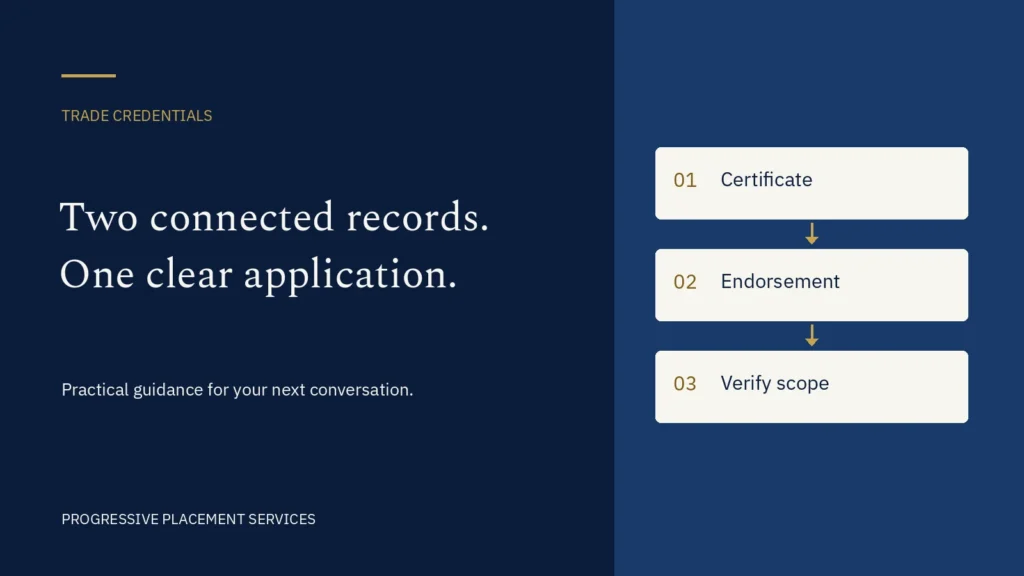
A Red Seal endorsement and a journeyperson certificate are connected, but they describe different things. The provincial or territorial authority issues the trade certificate. The Red Seal endorsement indicates that the holder has passed the interprovincial Red Seal examination for that trade.
For a job application, the useful question is not simply “Do you have your Red Seal?” It is “Which trade credential do you hold, who issued it, and does it meet the requirements for this work?” That distinction matters to both candidates and employers.
The certificate identifies the trade qualification
A trade certificate records a qualification issued by a provincial or territorial authority. Its title and the trade name may differ between jurisdictions. Read the wording on the document rather than translating it into a more familiar title that could mean something else.
For example, the Red Seal Heavy Duty Equipment Technician profile lists different provincial and territorial titles for that trade. Those variations are one reason a recruiter may ask for the issuing authority and the full credential name rather than relying on a résumé heading.
Being experienced in an occupation, completing a course and holding the applicable trade certificate are separate statements. Candidates should describe each accurately. Employers should establish which evidence the duties actually require before adding a blanket credential requirement.
The Red Seal endorsement shows an interprovincial examination standard
The Red Seal Program's official explanation says that the endorsement is affixed to a provincial or territorial certificate of qualification. It indicates that the holder has passed the Red Seal examination and has the knowledge required by the trade's occupational standard.
Red Seal is available for designated trades. It is not a separate licence that authorizes every kind of trade work, and the program directs certification verification to the relevant provincial or territorial authority. A candidate should therefore show the underlying trade certificate as well as the endorsement where applicable.
Do not use “Red Seal eligible,” “preparing for the exam” or “worked with Red Seal tradespeople” as substitutes for holding the endorsement. Those may describe genuine experience or plans, but they should be labelled as such.
A comparison for applications and hiring
| Item | What to identify | What still needs checking |
|---|---|---|
| Provincial or territorial trade certificate | Exact title, trade and issuing authority | Recognition and requirements where the work will take place |
| Red Seal endorsement | Endorsement on the relevant trade certificate | Underlying credential, trade match and any role-specific requirements |
| Apprenticeship registration | Authority and current registration or training status | Permitted work, supervision and the position's requirements |
| Additional qualification or site training | Issuer, scope and current record | Whether the particular work requires it and whether the record meets that requirement |
This table is a document checklist. It does not determine whether a person is authorized for a particular activity. That depends on the trade, jurisdiction and duties involved.
Working in another province requires a specific check
Do not assume that moving provinces always means starting again, or that the endorsement removes every administrative requirement. Check the destination authority's current information for the actual trade and credential.
Alberta's recognized trade credentials guidance explains how to check whether an out-of-province credential is recognized. Its Tradesecrets recognition tool allows a search by Alberta trade and issuing jurisdiction. The appropriate destination authority is the source for a recognition decision, not the wording of a general article.
If the certificate is unclear, ask before accepting duties that depend on it. A recruiter can help establish what an employer is asking for, but a recruiting conversation does not replace the authority's decision about certification or restricted work.
What an employer should verify
Start with the duties and the work location. Identify the relevant trade, any restricted activities and the evidence the position requires. Then compare the candidate's actual documents with those requirements. Avoid assuming that similarly named credentials are interchangeable.
Alberta's credential verification guidance provides examples of its certificates. The recognized-certificate guidance also explains that an employer seeking further verification should approach the issuing jurisdiction and establish any consent requirements. Use the relevant authority's process and an appropriate secure channel for personal documents.
Record what was checked, by whom and when. A résumé is a useful application document, but the label “journeyperson” on its own does not supply the full verification record. Ask for clarification when a document is incomplete or the name of the trade differs from the vacancy.
How to write the credential on a résumé
Use a heading such as “Trade credentials” and copy the official trade name. Add the issuing authority and indicate the Red Seal endorsement only if you hold it. Describe apprentice status separately. Include additional qualifications in their own lines so their scope is clear.
Illustrative format, not a credential claim: “Journeyperson certificate — [exact trade], [issuing province or territory]; Red Seal endorsement: [held, if applicable].” Replace the brackets with verified information and remove fields that do not apply. Do not publish a certificate number or other sensitive personal details merely to make a résumé look complete.
For an interview, be prepared to explain how your recent work relates to the trade on the document. If an employer uses a different title, ask which formal designation they mean. A short clarification early in the process is better than two parties making different assumptions.
Keep certification separate from additional work requirements
A trade credential is one part of an application. A position may also ask about particular equipment, a driving licence, a welding qualification, site training or other requirements. The posting and employer should clarify which are essential, how they are verified and what can be completed after hiring.
For welding roles, the CWB and Alberta B Pressure comparison shows why a trade certificate and welding qualification records need to be checked separately.
The PPS Resume Studio can help you present the information clearly. Employers can discuss their role requirements through skilled trades recruitment. For certification decisions, use the current provincial or territorial authority guidance for the trade and work location.