
Welder Interview Questions in Canada: Tickets, Safety and Practical Examples
A welder interview usually needs more than a list of processes you have used. Prepare to explain what you welded, the qualifications covering that work, how you checked the result and when you asked for help. A short, accurate account of one job is more useful than an answer that makes your experience sound broader than it is.
The questions below are practice prompts written by PPS Editorial. They are not an employer's question bank, a welding exam or a substitute for a practical assessment. Use them to organize your own experience before a Canadian shop, fabrication or field interview.
Start with the actual welding role
Read the posting once for the work and again for the evidence requested. Separate the process, materials, work setting, qualification requirements and schedule. A structural fabrication position and a pressure piping position may both advertise for a welder while requiring different experience and credentials.
Make a page with three columns: requirement, my evidence, question to clarify. Under evidence, record a real project, the approximate period and your responsibility. Put unfamiliar requirements in the question column rather than adding them to your résumé.
For background on the occupation, the Red Seal Welder occupational standard describes the trade's work activities. Use it to identify areas to review, not to claim competence in every activity it contains.
Questions about your experience and tickets
“Which welding processes have you used recently?” Name the processes you actually used, the setting and the kind of production work. Distinguish training practice from paid work. If most of your recent experience is with one process, explain that clearly before describing older experience with another.
“Which qualifications do you currently hold?” Bring legible records and describe the scope shown on them. Do not use “all-position certified” as a catch-all if the document has process, classification, validity or other limits. CWB's qualification guidance explains that tests cover a given process and position; your own record is the starting point for the employer's checks.
“Have you done work similar to this role?” Choose the closest honest match. Discuss material, joint preparation, drawings, fit-up, working position and the supervision involved, as relevant. If the role differs, identify the transferable work and the gap separately.
An apprentice should state registration and current training accurately. A qualification you plan to earn belongs in a discussion of development, not in the list of credentials you hold today.
For a clearer distinction between qualification records, review CWB vs B Pressure welding in Alberta.
Questions about quality and work planning
“How do you approach a new drawing or work package?” Explain how you establish what is required and resolve unclear information before starting. Mention the information you check and who you consult. Avoid implying that you change an approved procedure to suit personal preference.
“Tell us about a weld that did not meet requirements.” Describe what you noticed, how you reported it, who decided the next step and what you learned. Taking ownership is different from claiming authority to approve a repair or accept a weld when that was someone else's responsibility.
“How do you keep quality consistent under production pressure?” Use an example involving preparation, communication or an early correction. A useful answer explains a choice you made when speed and quality competed. “I never make mistakes” leaves the interviewer with little evidence about your judgement.
You do not need to reveal confidential drawings, customer names or proprietary production settings. Describe the work at a level that lets the interviewer understand your contribution without sharing protected information.
Questions about safety and speaking up
“What hazards would you check before starting a different welding task?” Discuss how you use the site's assessment and procedures, and when you would involve a supervisor. The Canadian Centre for Occupational Health and Safety's welding overview identifies hazards including fumes, radiation, electrical shock and burns. A credible interview answer connects the relevant hazard to the work setting rather than reciting a generic list.
“What would you do if asked to weld outside your qualification?” Explain how you would clarify the requirement, identify the limitation and seek an authorized next step. Do not promise to carry on because a deadline is tight. Read the qualification record rather than guessing what an old test covers.
“Describe a time you stopped to resolve a concern.” Explain what was uncertain, who you contacted and how work resumed after the concern was addressed. Do not turn the answer into a detailed procedure for an unfamiliar site. The interviewer is assessing your judgement and communication as well as your technical knowledge.
Build one answer that can stand up to follow-up
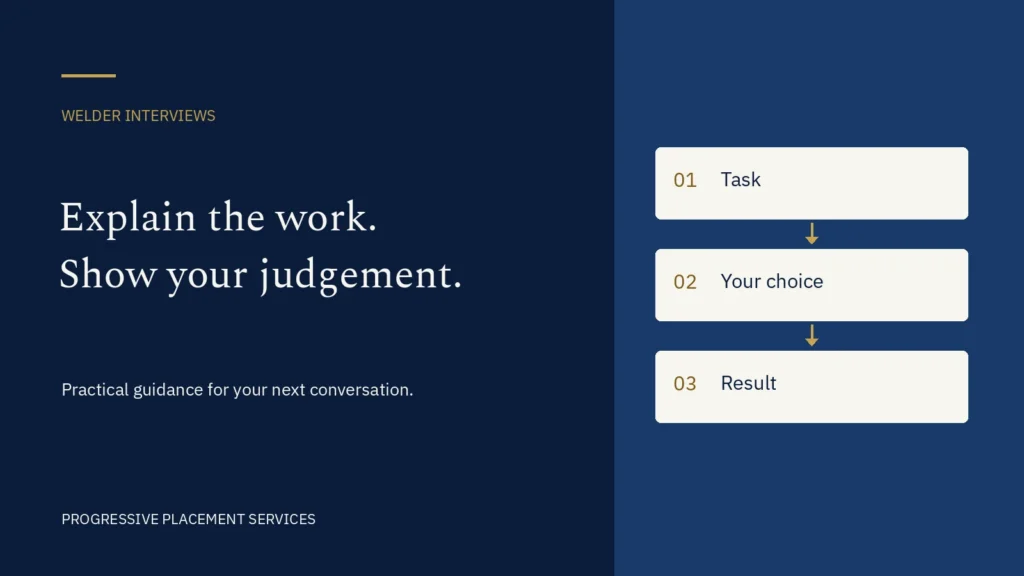
Use this four-part structure: the job, your responsibility, your action and the outcome. Keep the outcome factual. A measurement is useful only when you can explain where it came from and what it represents.
Illustrative answer structure, not a work-history claim: “On a fabrication assignment, I noticed the work information did not match what I expected at fit-up. I raised it with the supervisor before proceeding. We clarified the requirement, and I continued using the confirmed instructions. I now check that information earlier.”
Replace that example with a real event. Expect follow-ups such as “What was your decision?” and “What would you do differently?” Practise answering those aloud instead of memorizing a polished paragraph.
Ask about the practical assessment and conditions
Before attending, ask whether the appointment includes an interview, a practical assessment or both. Confirm the location, time, expected duration, required documents and what equipment or personal protective equipment you must bring. Ask who can clarify the test scope; do not assume every employer uses the same assessment.
During the conversation, ask about the main processes, the balance of shop and field work, supervision, typical schedule and how qualification checks are handled. These details help you assess the role as well as prepare for it.
Use the welder résumé guide to check that the experience and qualification details in your application match the examples you prepare.
Keep your documents consistent with your application. The PPS Resume Studio can help you organize your experience, and how PPS works with candidates explains the candidate journey. If you are exploring the employer side, see skilled trades recruitment.