
Skilled-Trades Hiring Checklist: Tickets, Work Evidence and Job Conditions
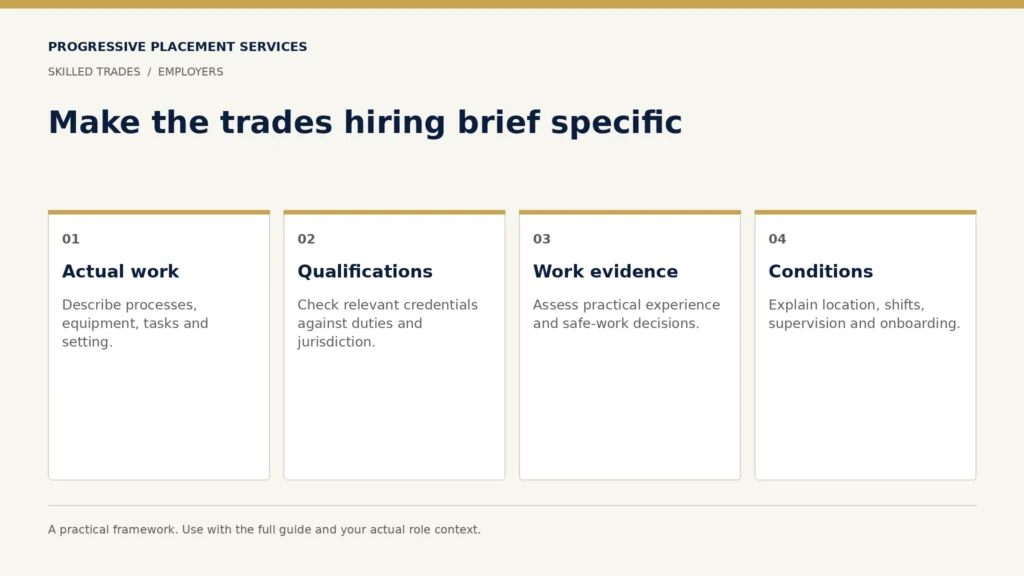
A skilled-trades hiring checklist should connect the work to the qualifications, experience and conditions actually required. Describe the tasks first, identify the relevant credential checks, assess practical work evidence and give candidates an accurate picture of the job before they decide whether to proceed.
This approach helps an employer distinguish three separate questions: Is the candidate appropriately qualified for the work? Have they done comparable work? Do the role's conditions fit what they can accept? A ticket list alone does not answer all three.
Define the work before listing tickets
Describe the equipment, processes, materials and setting the role involves. Distinguish shop work, field work, maintenance, installation, diagnostics and supervision where those differences matter. Clarify the quality, documentation and coordination responsibilities alongside hands-on tasks.
For a fictional example, “welder required” tells a candidate much less than a clear account of fabrication work, relevant welding processes, drawings and the expected work setting. The second description gives the employer a basis for deciding which qualifications and examples to ask about.
Identify which tasks are essential on arrival and which can be learnt through appropriate workplace training. Do not hide a lack of induction capacity behind a long list of supposedly essential experience. Equally, do not advertise training that the organisation cannot actually provide.
Verify credentials through the right issuing authority
The official Red Seal Program guidance explains that trade certification is administered by provinces and territories. It directs certification and endorsement verification to the authority that issued them. A Red Seal endorsement should not be treated as a replacement for checking the relevant underlying certification and permitted work.
Use the official apprenticeship and certification authority directory to find the appropriate source. Check the precise trade, credential and jurisdiction rather than assuming that a similar title describes identical authorisation everywhere.
Other qualifications may relate to a particular process, task, employer or worksite. Record who issued them, what they cover and whether further confirmation is needed. The existing CWB and B Pressure qualification guide explains why welding credentials should be discussed specifically instead of being treated as interchangeable labels.
Copy this employer hiring checklist
Use one working record per role. The prompts below are an illustrative recruitment tool, not a complete statement of trade, safety or employment requirements.
| Area | Information to establish | Evidence or action | Status |
|---|---|---|---|
| Work scope | Tasks, processes, equipment and setting | Confirm with the person accountable for the work | To complete / confirmed |
| Qualifications | Required credential, issuer and jurisdiction | Verify using the relevant authority or issuer | To verify / verified |
| Experience | Comparable work the person has performed | Discuss specific examples and responsibilities | To assess / assessed |
| Work conditions | Location, schedule, rotation, travel and physical setting | Give the same accurate role information to candidates | To confirm / communicated |
| Practical assessment | What task-relevant capability needs checking | Plan an appropriate, supervised assessment where needed | To plan / completed |
| Start and induction | Availability, orientation and initial supervision | Name the responsible internal contact | To arrange / arranged |
If a requirement is unclear, resolve it with the responsible specialist before presenting it as mandatory. Keep a record of the source and date of a credential check so a hiring decision does not depend on an unverified recollection.
Assess comparable work in useful detail
Ask candidates to describe recent relevant work: the setting, the task, the materials or equipment, their responsibility and how they checked quality. Follow up on the difference between assisting with a task and being accountable for it.
For maintenance or diagnostic work, explore how the person approached an unfamiliar problem, selected the next check and communicated findings. For fabrication or installation, ask how they interpreted the work information, dealt with a discrepancy and documented the result. Adapt the discussion to the actual role rather than using a generic technical quiz.
Ask about learning needs as well as strengths. Honest identification of unfamiliar equipment can support a sensible induction plan. Confidence without a clear account of experience should not be treated as equivalent evidence.
Make practical assessment relevant and safe
Where practical assessment is appropriate, define the capability being assessed and the conditions in which it can be assessed properly. Use a competent person to plan and supervise it. Ensure that candidates understand the task and have an appropriate opportunity to demonstrate the work.
Do not improvise hazardous tasks to test someone's confidence, or ask a candidate to carry out work beyond the verified conditions of the assessment. A recruitment checklist does not replace the employer's established worksite, safety or technical procedures.
Record what was observed and any limitations. A successful assessment of one task does not establish proficiency in every process or piece of equipment. Connect the findings back to the job requirements and the support available after appointment.
Explain conditions before the final decision
State the actual work location and arrangements, including any travel or relocation discussion. Candidate reach and workplace location are different: a person living elsewhere in Canada may be interested in the role, but still needs to understand where and how the work is done.
Clarify the schedule, rotation where applicable, expected availability and the known compensation arrangements. Explain what is confirmed and what remains to be discussed. Avoid using “competitive” or “flexible” as substitutes for information needed to assess fit.
Be clear about supervision, team structure and what equipment or support the employer provides. These details can affect whether a capable person can perform the job as expected. They also help prevent late-stage disagreements based on different assumptions.
Connect hiring to progression and retention
If the role includes coaching apprentices, coordinating others or taking on supervisory duties, assess those responsibilities separately from trade proficiency. A strong individual contributor may need development before managing schedules, giving feedback or handling conflicting priorities.
The tradesperson-to-supervisor career guide helps describe that next level of evidence. Use it to make progression responsibilities concrete rather than promising an automatic route into management.
Plan the first work period: who confirms requirements, who introduces procedures, who answers questions and who reviews early work. Useful onboarding is part of the hiring design, not a substitute for checking essential qualifications beforehand.
Prepare a useful recruitment conversation
PPS's Skilled Trades practice describes recruitment for industrial, construction and maintenance employers in Northern Alberta. Relevant candidates from across Canada can express interest, with workplace and work arrangements discussed for each role.
To discuss a hiring need, request a skilled-trades search conversation. Share the actual work, relevant qualifications, location, schedule and timing. A clear checklist gives PPS a stronger basis for assessing the role and identifying the evidence an employer needs.