
Heavy-Duty Mechanic Interview Questions in Canada: Diagnostic and Safety Examples
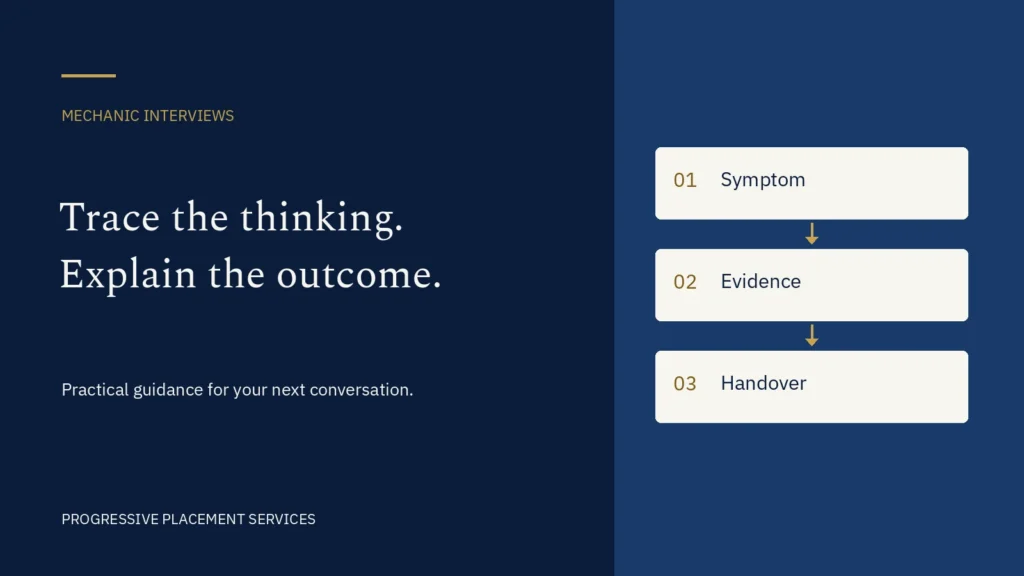
For a heavy-duty mechanic interview, prepare examples that show how you think through a problem, protect people and communicate the repair. Naming equipment brands is useful context, but it does not explain your diagnostic decisions or the limits of your experience.
These practice questions are written by PPS Editorial for Canadian job applicants. They are not an employer's assessment, a Red Seal exam or repair instructions. The strongest preparation uses your own work history and the requirements of the particular role.
Establish which equipment the job actually covers
“Heavy-duty mechanic” is a common hiring title, but the equipment and formal trade designation can differ. The Red Seal Heavy Duty Equipment Technician profile lists provincial title variations and describes work across several sectors. Ask whether the position centres on off-road equipment, a particular fleet or a mix of duties.
Separate hands-on experience from equipment you have only observed. Record the systems you worked on, the kind of environment and whether you performed the task independently, under supervision or as part of training. This helps the employer place your experience accurately.
For each main requirement in the posting, prepare one work example and one question. If the posting asks for a credential, bring the actual document and state its issuing authority. Do not assume a familiar job title proves the credential matches the position.
“Walk us through a difficult diagnosis”
Choose an example you understand well enough to discuss without notes. Start with the reported symptom and operating context. Explain what you confirmed, which information you consulted and why you selected the next check. Keep the account focused on your decisions rather than presenting every action taken by the whole shop.
A useful answer separates an observation from a hypothesis. “The operator reported intermittent power loss” and “I suspected a particular fault” describe different things. Explain what changed your thinking, including any evidence that ruled out your first idea.
Finish with what was established and how the result was checked within your responsibility. If someone else approved return to service, say so. Avoid turning the interview answer into a general troubleshooting sequence that another person might apply to different equipment.
“Tell us about a time the first repair did not solve the problem”
This question gives you room to show accountability. Explain what remained unresolved, how you revisited the evidence and when you involved another technician, supervisor or technical support resource. A defensible account can include uncertainty; a claim that you always identify the fault immediately is harder to assess.
Do not invent a cost saving or downtime figure. If you have a documented result you are permitted to share, give its basis. Otherwise, describe the actual outcome, such as a confirmed cause, a completed verification or a clearer handover to the next shift.
An apprentice can use an example showing good observation, accurate reporting and appropriate supervision. The example does not need to portray you as the person who authorized every decision.
“How do you prepare for maintenance involving stored energy?”
Discuss your training, the site's procedures and how you confirm the task is within your authorization. The Canadian Centre for Occupational Health and Safety's hazardous energy guidance explains that unintended movement, start-up and stored-energy release need to be addressed. Describe how you recognize the need for the appropriate controls and seek clarification when conditions differ.
Raised components are a separate point worth preparing to discuss. Ontario's equipment blocking alert highlights gravity, hydraulic pressure and other stored-energy hazards. Do not give an interviewer a universal shortcut such as “switch it off and begin.” Explain how you follow the applicable equipment and site requirements.
This is an interview discussion, not a practical demonstration. If asked to perform a task, establish the supervision, authorization and safety arrangements before participating.
“How do you document work and hand over a machine?”
Use a real example involving a work order, shift change or unresolved concern. Explain how you distinguish reported symptoms, observations, work completed and work still required. The next person needs to understand what has been verified and what remains uncertain.
Discuss the level of detail you would expect in your own records. Useful information may include the equipment identifier, relevant observations, parts or work performed and the next action. Do not bring confidential maintenance records to an interview without permission; describe your approach or create a clearly fictional sample instead.
Be ready for a communication question about an operator. Explain how you gathered information respectfully and checked that you understood the complaint. Blaming the operator adds little evidence about your ability to investigate it.
Prepare examples beyond fault finding
An employer may also ask about competing priorities, an unfamiliar system or a disagreement about the next step. Prepare a small set of distinct examples rather than forcing every question into one repair story.
| Practice prompt | Evidence to prepare |
|---|---|
| Two urgent jobs arrived together | How priorities were clarified and communicated |
| You encountered unfamiliar equipment | How you identified the limit of your knowledge and obtained support |
| A part or resource was unavailable | How you reported the constraint and agreed on the next step |
| A colleague challenged your conclusion | How you checked the evidence and responded |
These are editorial preparation prompts, not claims about what every Canadian employer asks. Match the examples to the actual vacancy.
Questions to ask before accepting the next step
Ask about the fleet, shop versus field split, diagnostic resources, supervision and expected rotation. Clarify tools, service vehicles, call-out arrangements and required tickets rather than assuming they are included. If there is an assessment, ask what it covers and what you should bring.
Use the heavy-duty mechanic résumé guide to align the equipment, dates and trade standing in your application with the examples you will discuss.
Review your résumé before the interview so that dates, equipment experience and trade standing match what you say. The PPS Resume Studio offers a place to organize that information. Read how PPS works with candidates for the recruiting process, or explore skilled trades recruitment for employer hiring support.