
CTO, CIO or Head of Technology: Scope the Leadership Hire
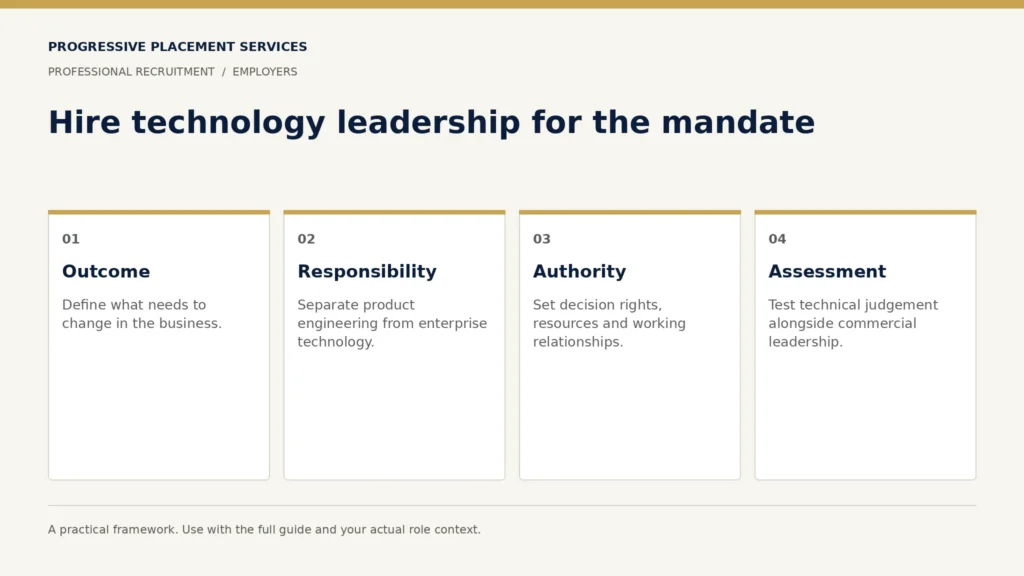
To decide whether to hire a chief technology officer, chief information officer or head of technology, start with the business and technology decisions the person must own. Define the product or service context, operating responsibilities, team, resources and risks before choosing the title.
Organisations use these titles differently. A useful search brief makes the boundaries explicit so candidates can assess the real mandate and employers can evaluate relevant experience instead of assuming that every senior technology title represents the same work.
Begin with the outcome behind the hire
Describe what the business needs technology leadership to make possible. Is it building a software product, improving enterprise systems, stabilising service delivery, coordinating an investment programme or leading an established technical team through change?
Separate the business result from the technology activity. Installing a platform is an activity; enabling a reliable operating process with clear ownership is a broader outcome. The leader may contribute to that outcome without controlling every commercial or organisational decision behind it.
Name the constraints. These can include a legacy environment, limited management depth, dependencies on suppliers, investment decisions or a product commitment. The candidate needs to understand what can be changed and where negotiation with other leaders will be necessary.
Compare responsibilities before selecting a title
The table describes possible organisational patterns, not universal definitions. Some employers combine these responsibilities, while others divide them between several leaders.
| Role label under discussion | Possible emphasis | Scope question |
|---|---|---|
| CTO | Technology supporting a product, platform or technical strategy | Does the role own engineering delivery, architecture, research or a combination? |
| CIO | Enterprise information systems and technology-enabled operations | Which services, systems, information and organisational changes are included? |
| Head of technology | Leadership of a defined technical function or team | What decisions sit here and what remains with another executive? |
The official NOC profile for computer and information systems managers illustrates the breadth of management work across developing, implementing and operating systems. It does not establish a universal division between CTO and CIO titles.
For a concrete example, a Toptal CTO specification, reviewed November 8, 2026, brings together engineering execution, technical architecture, workforce planning and team development. That is one employer's mandate, not a universal CTO definition or a PPS vacancy. Published role descriptions can change or close; use them to investigate responsibilities rather than copy their requirements into an unrelated search.
Set product, business and technology decision rights
Decide who owns product priorities, architecture, engineering methods, operational services and investment choices. Clarify the relationship with the chief executive, finance, operations and commercial leadership. Shared work still needs a clear way to make decisions.
For a product business, discuss how customer needs, commercial priorities and technical constraints will be brought together. For enterprise systems, identify who owns the process changes needed alongside implementation. Do not hold the technology leader solely accountable for adoption decisions that another function controls.
Write down the executive forums and escalation routes. A reporting line alone does not explain how a leader can resolve a cross-functional disagreement. The organisation should be ready to describe how the new appointment will gain the information and authority needed to act.
Copy this technology mandate worksheet
Use the prompts to create a short working brief. The worksheet is an original recruitment aid, not a technology governance standard or a complete risk assessment.
| Brief field | What to define | Candidate evidence to explore |
|---|---|---|
| Business outcome | The problem or capability behind the appointment | Connecting technical decisions to relevant business needs |
| Technical scope | Product, platforms, systems, services and suppliers included | Comparable delivery and operating responsibility |
| People | Team structure, management capability and vacancies | Developing managers and appropriate technical leadership |
| Authority | Decisions, resources and escalation responsibilities | Working through consequential trade-offs |
| Risk | Important reliability, information and security concerns | Appropriate oversight, specialist involvement and response planning |
| Change | Organisational work needed alongside technical delivery | Building adoption and resolving cross-functional dependencies |
If the brief requires everything from daily technical troubleshooting to enterprise strategy, test whether the capacity and team make that credible. A more senior title does not make conflicting workloads disappear.
Assess technical judgement without a buzzword checklist
Ask candidates to explain a consequential technical decision in a comparable context. Explore alternatives, constraints, the information available at the time and the effects on delivery. The hiring team should understand why the decision made sense, not simply recognise the names of technologies used.
Where specialist technical assessment is needed, involve someone competent to judge that part of the work. Separate this from the assessment of leadership and commercial judgement. One impressive technical conversation does not establish the person's ability to lead the whole mandate.
Do not require experience with an emerging technology solely because it is fashionable. Explain the actual work or decisions that make it relevant. If the role needs to evaluate unfamiliar options, assess the candidate's method for learning and making responsible choices.
Make service, security and supplier responsibilities explicit
Technology leadership can involve important operating responsibilities beyond implementation. Clarify who owns service continuity, access decisions, supplier relationships and incident escalation. The right design depends on the organisation's systems and risk context.
The Canadian Centre for Cyber Security's baseline guidance for small and medium organisations includes incident response, access control, backups and outsourced services. It provides useful topics to discuss within its scope, not proof that hiring one executive will meet every security need.
Ask how candidates have worked with specialist expertise and made responsibilities clear. Avoid expecting one technology leader to be the sole expert in every system, threat and organisational requirement. Assess how they create a workable management approach and know when to seek deeper input.
Examine people leadership and change delivery
Explore a situation in which the candidate had to strengthen a team, resolve competing priorities or change a delivery approach. Ask what they personally owned and how they involved people doing the work. Look for an explanation of what persisted after the initial intervention.
The executive hiring scorecard can help record this evidence alongside technical judgement. For candidate preparation, the technology leadership career guide describes the responsibilities and examples worth developing before pursuing a broader seat.
Agree a proportionate practical discussion if it would help. Use a fictional or suitably redacted scenario and assess the candidate's questions and reasoning. Do not ask for confidential product plans or free solutions to a live client problem.
Choose the recruitment route and capacity
Some needs belong in a continuing specialist management role; others require executive responsibility or bounded leadership cover. The interim and fractional comparison helps separate duration, working pattern and authority.
PPS's Professional Recruitment practice covers technology and other professional functions, while Executive Search addresses relevant director-through-C-suite mandates. To discuss the right route, request a technology hiring conversation and share the outcome, technical scope, team and decisions the role must own.