
Shop vs Field Welding Jobs in Alberta: Compare the Work Before Applying
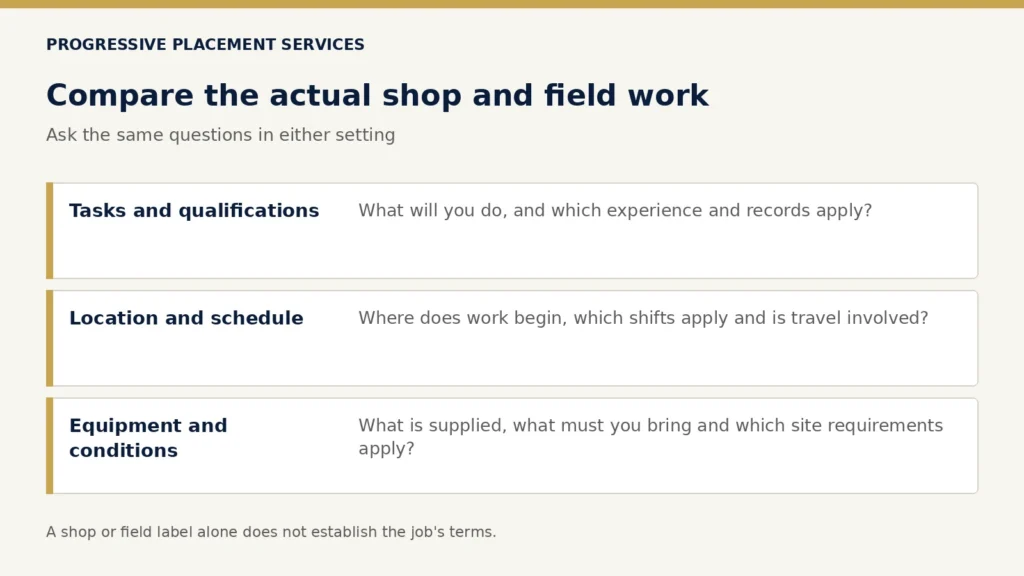
“Shop” and “field” describe where welding takes place, but they do not tell you the whole job. A shop role can involve varied fabrication and repair. A field position can involve a fixed site, changing customer locations or a mixture of indoor and outdoor work. Some employers combine both settings.
When comparing shop and field welding jobs in Alberta, use the actual duties and terms to decide where your experience fits. The Alberta alis welder profile describes shop and outdoor work and notes that some welding work involves travel. Individual employers set the arrangements for their own roles.
If you are exploring your next move, view advertised PPS opportunities or register your résumé with your work preferences. Be specific about what you would consider so a recruiter can assess fit more accurately.
Compare tasks before comparing labels
Start with a recent work example you can explain. What were you making or repairing? Which part did you perform? Which processes, materials, drawings and quality requirements were involved? That example is more useful than calling yourself comfortable with “all welding.”
Read each posting for the same details. A setting that sounds familiar may involve a different product, process or level of responsibility. Conversely, your experience may transfer to a new environment when the underlying work is similar and the employer can provide the appropriate orientation and supervision.
| Dimension | Questions about a shop role | Questions about a field role |
|---|---|---|
| Daily work | Is it production, custom fabrication, repair or a mix? | Is it installation, construction, maintenance, repair or a mix? |
| Location | Is the work at one shop? Are customer visits included? | Is there a fixed site, changing sites or work away from home? |
| Schedule | Which shifts apply? How are changes communicated? | Which shifts or rotations apply? How is travel scheduled? |
| Equipment | Which machines, handling equipment and personal tools are used? | Which equipment is provided at each location and who transports it? |
| Quality requirements | What records, inspections and qualifications apply? | What procedures, site controls and qualifications apply? |
| Work conditions | What are the actual work areas and site requirements? | Which outdoor, access or customer-site conditions are involved? |
The questions deliberately leave room for different answers. A shop is not automatically a fixed-hours role, and field work does not automatically mean camp, a company truck or a particular rotation.
Think about how you prefer to work
Consider the rhythm of the job. Do you prefer a known worksite and an established production team? Are you comfortable travelling to different locations and adapting to site-specific arrangements? Would you accept a mixed role if travel expectations were clear?
Separate preferences from firm limits. “Prefer days” leaves room for a conversation. “Available for day shifts only” communicates a requirement. Explain either one accurately. A recruiter cannot reliably match you if a preference is presented as unrestricted availability and later becomes a condition of accepting an offer.
Review the practical effect on your week. Think about the commute, personal commitments, travel notice and recovery time. You do not need to disclose private family circumstances to explain which schedule or location you can accept.
Match qualifications to the duties in either setting
A shop label does not make every role suitable for the same qualifications. The same is true of field work. Check the required trade status, process qualifications and any additional requirements against the work described.
Alberta's Welder trade profile identifies the authorization needed for restricted activities. Employer assessment and training arrangements should be discussed alongside those requirements. For an explanation of separate welding credentials, use our CWB versus B Pressure guide.
List the qualifications you hold using their proper names. If you have strong structural fabrication experience but limited pressure work, explain that boundary. If you have completed relevant training without holding the qualification named in the advert, distinguish the two. Clear limits help identify an appropriate role and the questions that need answering.
Make travel and equipment arrangements explicit
For any role involving movement between sites, ask where a typical day starts and ends. Clarify transport arrangements, expected destinations and the notice normally given for travel. If working away is possible, ask which accommodation and expense arrangements actually apply. Request the details in writing before making a commitment.
For both shop and field jobs, ask what the employer supplies and what the worker must bring. A posting's mention of tools is a starting point for clarification. Ask about storage, transport and replacement arrangements where relevant. Do not buy significant equipment based only on an informal statement that you will “probably need it.”
These questions help you understand the job. They are not assumptions about what an employer must provide or promises that a particular benefit is available. Where a term remains unclear, leave it marked as unknown in your comparison.
Show relevant evidence in your application
Tailor your résumé to the environment and duties you can support with real examples. The welder résumé guide offers a structure for presenting your trade work. For shop work, that might include the assemblies you fabricated, drawing interpretation, fit-up responsibilities or handover records. For field work, it might include adapting to site arrangements, coordination with other trades and the tasks you completed under the site's requirements. Use only examples that are yours to share.
Avoid copying a long list of processes or equipment into every application. Put the most relevant experience first, then give enough context for the reader to understand your contribution. If a role combines shop and field work, explain where you have experience and where you would need orientation or further assessment.
Send a work-preference note a recruiter can use
This fictional example shows a format you can adapt; it does not describe a PPS applicant or an available vacancy:
“I am based in Edmonton and seeking shop fabrication work. I would also consider a mixed shop/field role with travel arrangements confirmed in advance. My recent experience is with [your actual processes and products]. I am available after [your notice period] and can discuss [your actual shift availability].”
Replace every bracket with accurate information. If you are considering Calgary, another Alberta community or a move from another province, say which locations are realistic. The Edmonton and Calgary guides provide context for those markets, while the individual posting establishes the job's worksite.
Choose the next step that fits your search
For an overview of the practice, see PPS skilled trades recruitment.
Apply through a specific job posting when its duties and conditions match what you can offer. Otherwise, submit your résumé for relevant PPS searches and state your shop, field or mixed-work preferences. General registration keeps the conversation focused on your actual interests; it does not reserve a role or guarantee contact.